


Anderson LimaSoftware Engineer & Architect
October 24, 2026
8 min read
0 views

The project is late. Three people have six weeks until the desired date, and someone proposes adding two more to recover the plan. New arrivals need decisions explained, access granted and work reviewed. The calendar has gained participants; whether it has gained work that can finish sooner remains unclear.
Frederick P. Brooks Jr.'s The Mythical Man-Month helps examine that difference. I recommend it for discussing deadlines without treating people as interchangeable units. Questions about division, training and integration matter to developers without management titles too.
This review considers the twentieth-anniversary edition published in 1995, revisiting the 1975 original. Addison-Wesley/Pearson's listing dates publication to August 2, 1995, and describes additional essays and reflections. Brooks' IBM System/360 and OS/360 experience forms part of its setting.
This edition lets readers compare arguments with later reconsideration instead of retaining one famous phrase. Use the essays as hypotheses for investigating today's project. They cannot supply an equation predicting delays in a team nobody has observed.
Some work partitions almost independently; other work depends on an earlier decision. When two implementations await a contract definition, additional implementers cannot automatically settle it. Distributing work before that decision may produce two incompatible interpretations.
The argument associated with Brooks' law warns about adding people to a late project. My practical reading examines its conditions: short deadlines, coupled work, concentrated knowledge and integration costs. Turning it into a universal hiring prohibition would discard situations where specialists genuinely unlock work.
Separate effort from duration too. A review requiring half a day can wait three days in the knowledgeable person's queue. Adding everyone else's available hours cannot remove that wait. Planning needs dependencies and decision-maker availability alongside total estimated effort.
Consider a hypothetical service migration. Work remains on defining a message format, implementing producer and consumer, reconciling data and rehearsing cutover. Format decisions block producer and consumer; cutover requires both working together. Six weeks is a desired date rather than a validated forecast.
Before adding two people, inspect the first two working weeks. Assume ten working days per person with no absences. This is teaching arithmetic about availability, not measured productivity or estimated project effort. Activities common to both plans are excluded; listed costs are incremental.
| Item in the first two weeks | Three people | Five people |
|---|---|---|
| Gross availability | 3 × 10 = 30 person-days | 5 × 10 = 50 person-days |
| Learning by two new arrivals | 0 additional | 10 person-days |
| Mentoring by existing members | 0 additional | 6 person-days |
| Additional review and integration | 0 additional | 4 person-days |
| Balance after these costs | 30 person-days | 30 person-days |
Ten learning days means five per newcomer; six mentoring days and four additional days consume existing members' availability. No individual's time is subtracted twice: learning and mentoring occupy different participants. Challenge every assumption against actual tasks.
The result cannot prove hiring is useless. Under these assumptions, initial gross gains are consumed. Nor does the balance convert into delivered code: dependencies, specialization and waiting remain. The subsequent four weeks require separate analysis. Extrapolating a delay percentage from this table would be unjustified.
Suppose a specialist knows the reconciliation tool and can prepare a checker against a stable data set. Work may begin before message format is final if the checker has an independent contract. Its expected result identifies missing records and differences by identifier without changing production data.
For a bounded checker task, the reference set might contain A-1, A-2 and A-3, while the migrated set contains A-1 and A-3. Expected output identifies A-2 as missing and reports no unexpected identifiers. This gives the specialist an independently reviewable result before message-format decisions finish. These invented records test the task's boundary; they cannot establish production migration completeness. If defining the reference set requires unresolved schema decisions, the task is not independent after all. That observation would invalidate the proposed assignment rather than merely changing its estimated effort. Use the example to challenge the partition, not to certify the real migration.
The second newcomer might prepare the rehearsal environment when access, infrastructure and completion criteria are clear. Validators still need allocated time, but these tasks need not depend on the same detail blocking producer and consumer.
This alternative changes the decision when observations confirm low entry costs, autonomy and short integration. If every question still needs the person resolving message format, independence was only apparent. State what would make you reconsider instead of defending hiring or small teams as principles.
Free and paid products to turn ideas into a foundation you can actually ship.
13 products available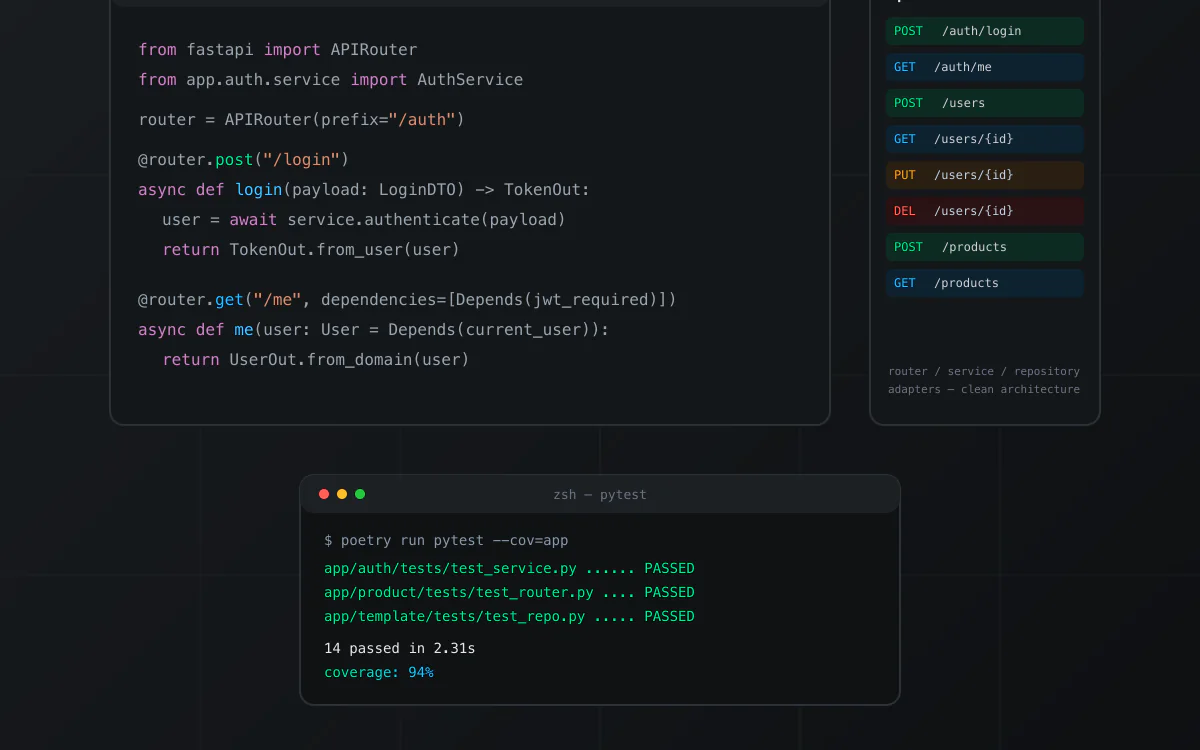
nextjs · boilerplate
Boilerplate de API em Python com FastAPI, organizado em Clean Architecture (router, service, repository e adapters por módulo). Inclui autenticação JWT com hashing bcrypt, MongoDB, testes com pytest e cobertura, Dockerfile e docker-compose para subir localmente, e documentação Swagger/OpenAPI automática. Repositório de origem privado; snapshot técnico verificado antes da publicação.
View product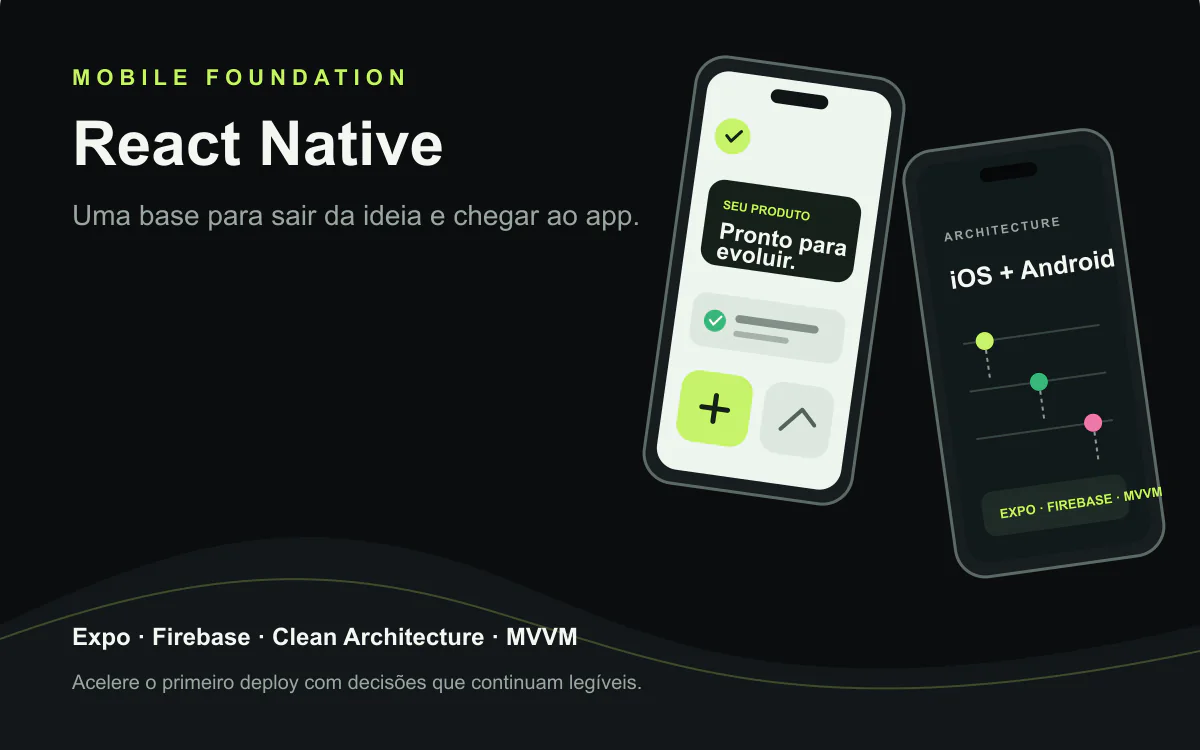
react · boilerplate
A React Native foundation for iOS and Android apps with Expo, Clean Architecture, MVVM, Firebase, and native modules. Technical reference from VaiDeFut, with public Google Play distribution and a documented iOS publishing flow.
View product
nextjs · boilerplate
A free open-source kit for getting started with coding agents across Claude Code, Codex, Gemini, Copilot, and OpenCode. The public repository confirms an MIT license.
View product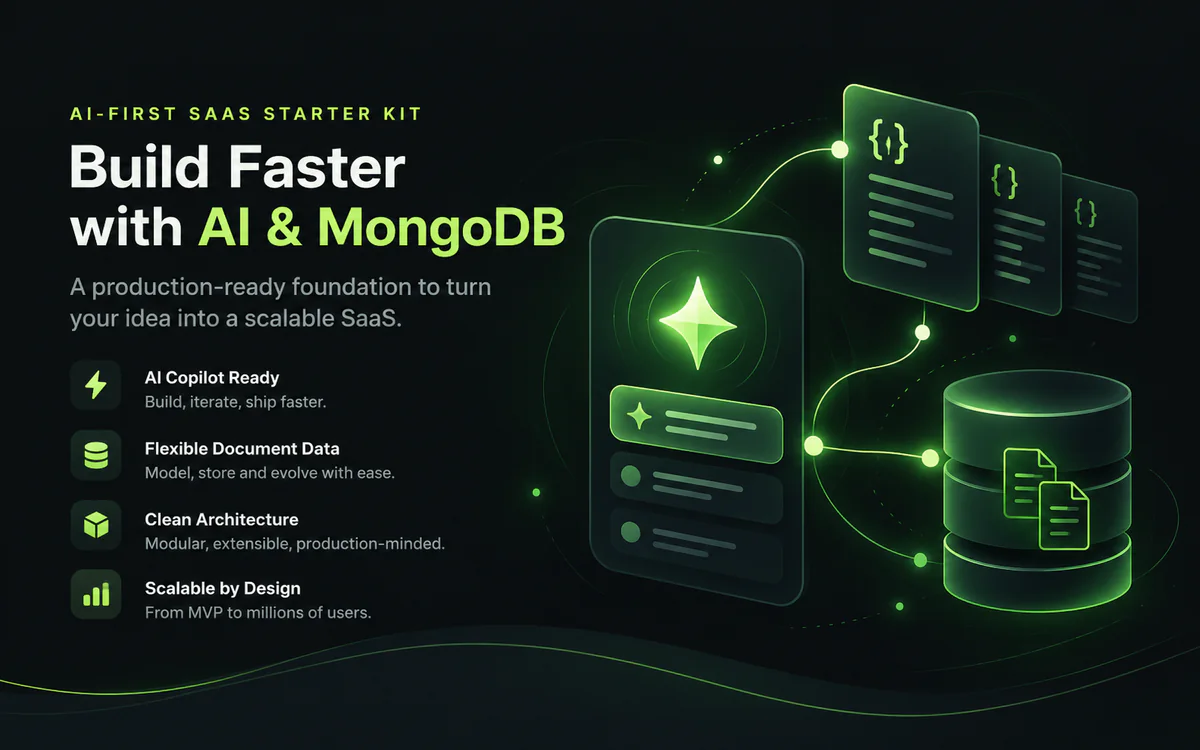
nextjs · boilerplate
A white-label AI-first foundation for shipping SaaS products with Next.js, chat, RAG, memory, tenants, and documentation. The verified snapshot documents Supabase rather than MongoDB; that limitation is explicit. MongoDB, Redis, and RabbitMQ require a compatible integration/configuration.
View product
nextjs · boilerplate
An advanced white-label, multi-tenant AI-first foundation for accelerating products with Next.js, chat, RAG, memory, and documentation. The verified snapshot does not prove a distinct Ultra layer; that limitation stays explicit while provider, cache, and queue swaps remain visible.
View product
nextjs · boilerplate
A white-label, multi-tenant foundation for turning an idea into an AI-first SaaS with Next.js, chat, RAG, memory, and documented security. The verified snapshot uses Supabase; the name identifies the source repository. Provider, cache, and queue boundaries stay explicit; Redis and RabbitMQ are configurable integrations.
View product
react · portfolio
A one-time contribution that supports free technical content, research, and the continuity of relevant projects published by Anderson Lima. You choose the amount; there is no subscription.
View product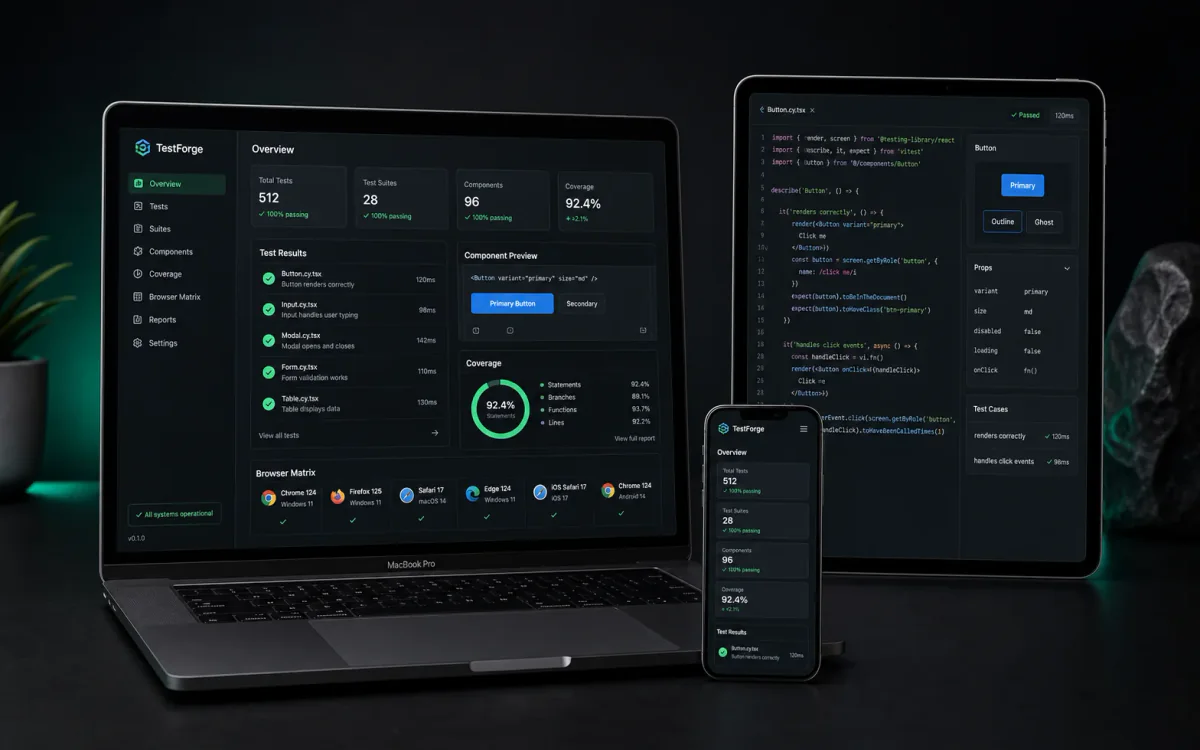
react · boilerplate
A free React starter for building a reliable test suite from the first commit, combining Vitest, Testing Library, Playwright, Vite, TypeScript, Zustand, React Query, MirageJS, and PWA. The repository does not declare an SPDX license; review its terms before commercial use.
View product
react · portfolio
A public React, TypeScript, and Vite monorepo for exploring a component library with a native-inspired visual language. The current README is minimal and does not declare an SPDX license; treat it as a free preview.
View product
nextjs · saas
An AI-first SaaS boilerplate with Next.js, Supabase, Stripe, and provider routing to move from the first prompt toward a real deployment faster. AI, data, email, cache, and queue adaptations stay explicit; Redis and RabbitMQ are configurable integrations.
View product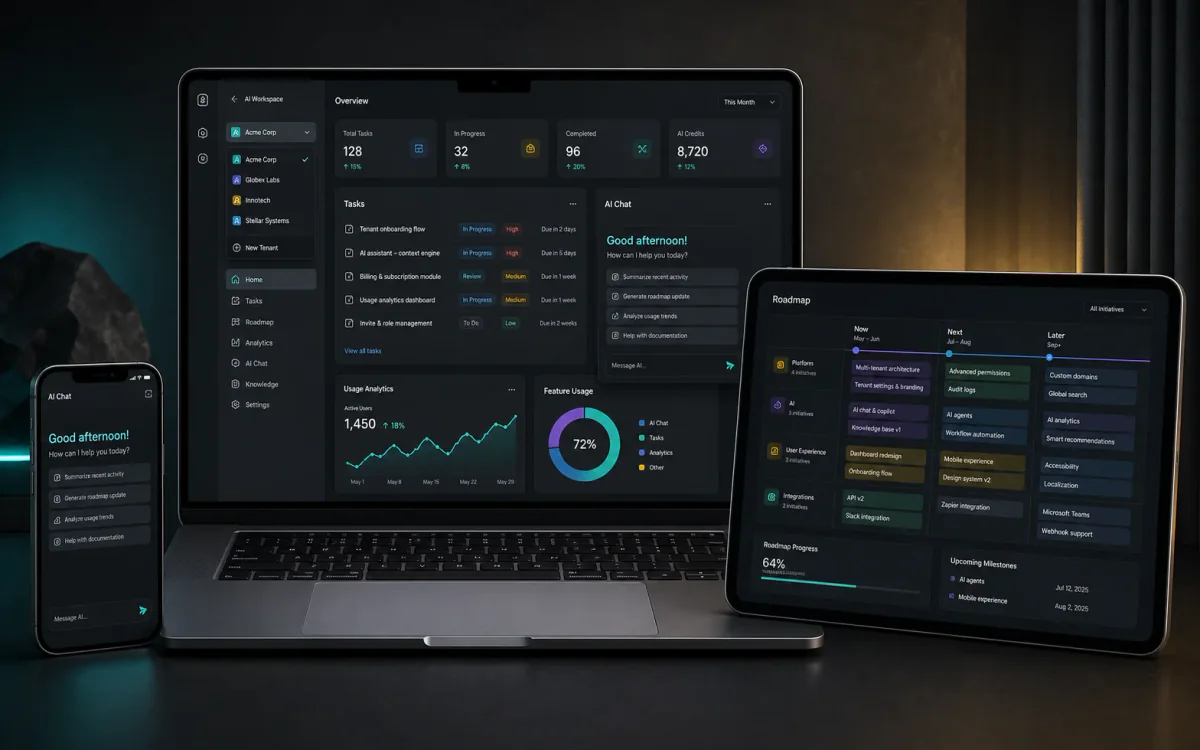
react · saas
A React + TypeScript starter for multi-tenant SaaS with Firebase, Atomic Design, themes, PWA, product screens, MirageJS, and Gemini chat extensible to other providers. Validate production requirements, costs, and integrations before publishing.
View product
react · boilerplate
A public React starter with TypeScript, Zustand, React Query, Tailwind CSS, PWA, and documented AI integrations. The repository does not declare an SPDX license; review its terms before commercial use.
View product
nextjs · saas
A Next.js, TypeScript, and Tailwind CSS SaaS landing page with SEO, themes, i18n, PWA, and integration points for auth, Stripe, and AI. A clear foundation for leaving the blank screen behind and shaping your positioning.
View productContinue exploring similar topics
Use Team Topologies to examine cognitive load, dependencies and internal services before redesigning teams.
Use Peopleware to investigate interruptions, trust and working conditions without reducing people to individual metrics.

Apply Michael Nygard's approach to timeouts, isolation and recovery through a controlled failure exercise.
A 47-point checklist to find bugs, security risks, and performance issues before launch.
Production-tested templates trusted by developers. Save weeks of setup on your next project.
Three people have 3 × 2 / 2 = 3 pairs; five have 5 × 4 / 2 = 10. The expression n(n-1)/2 counts possible pairs. It cannot establish ten meetings, inevitable quadratic duration or productivity. People and tasks need not communicate with every other participant equally often.
The count still prompts questions about knowledge circulation. Clear contracts and decision ownership can reduce unnecessary coordination. Accessible documentation helps when it reflects work and makes decisions findable instead of merely accumulating pages.
Project structure changes the cost. A group modifying the same rule needs different negotiation from groups with a stable boundary. Communication tools permit information exchange without resolving disagreement about message meaning or automatically distributing decision authority.
The sample chapter on conceptual integrity presents Brooks' concern with design coherence. It helps inspect what task division can conceal: every part finishes, yet similar system operations require incompatible explanations.
Our producer and consumer must agree on identifiers, errors and compatibility. One treating an absent field as a default while another rejects the message cannot be resolved by approving each independently. Shared contracts and examples must expose that disagreement before cutover.
My application assigns ownership and review mechanisms to maintain coherence. One manager need not approve every detail. A single person can become a bottleneck or knowledge concentration. Distributed decisions work when boundaries and conflict resolution are explicit.
Integration involves more than resolving textual Git conflicts. Our exercise includes format, data, compatible deployment and transition behavior. A green pipeline running separate tests cannot establish that reconciliation accepts records produced by the new service.
Plan executable intermediate versions and rehearsals before the final date. A producer emitting a known example and consumer interpreting it provide more concrete evidence than two completed task cards. Include rejected cases and compatibility with the still-operating path.
Retain rollback and observation work in the plan. Establish who stops cutover, which signals guide that decision and how partially migrated data is identified. Hiring implementers cannot eliminate those tasks or automatically assign them to operations.
The September 1986 report No Silver Bullet, TR86-020 distinguishes essential problem difficulties from accidental difficulties of representation and tools. The essay belongs to material included in the anniversary edition. Its challenge helps ask which work a tool actually removes.
Automating code generation for our migration may reduce repetitive writing. Decisions about cancellation semantics, authoritative data and completed cutover remain. Improving mechanisms can reduce implementation cost without resolving conceptual disagreement.
That does not justify dismissing tools or projecting an old prediction onto current technology without evidence. Separate the proposed gain: less mechanical work, fewer integration errors or faster decisions? Each promise needs a different observation method.
Large systems and authority structures of the period do not represent every present-day team. Continuous integration, automation and remote collaboration change costs and possibilities. OS/360 experience cannot directly estimate a small product built from familiar components.
Question architectural centralization too. Coherence can help while concentrating review in one person obstructs learning and decisions. Compare inconsistency risk with queueing and absence risk, choosing continuity mechanisms.
The essays mix experience, reasoning and judgment. Their strength is making forgotten costs debatable rather than providing organizational physics. Even the title's historical unit warrants care: people bring different knowledge, and coordination depends on relationships and work design as well as headcount.
I recommend it to anyone participating in estimation, review and integration without requiring management responsibility. Beginners can recognize one question interrupting another task and learn to expose dependencies. Understanding operating-system history is unnecessary for challenging delivery plans.
If you want introductory programming or implementation techniques, another book may pay off sooner. Do not expect a contemporary agile-planning manual either. Use Brooks to examine scheduling assumptions, supplemented by observations of your own team and suitable tools.
Peopleware expands discussion of environments and people. Team Topologies examines team boundaries and interactions. Accelerate complements delivery analysis. Brooks keeps attention on dividing work and integrating the product.
Read scheduling and integrity essays with one project in mind. Map work that can proceed independently and identify owners of pending decisions. Build an availability ledger with explicit assumptions before announcing additional capacity.
After a team change, record learning time, review waits and integrated outcomes. Compare observations with the plan and adjust tasks or boundaries. These findings can inform the next decision without making a small experience universal.
I recommend the anniversary edition for exposing work hidden by adding up people. You have used it well when you can explain which activities a newcomer unlocks, which temporarily shrink and why this can change the delivery date.