

Anderson LimaSoftware Engineer & Architect
October 24, 2026
10 min read
0 views
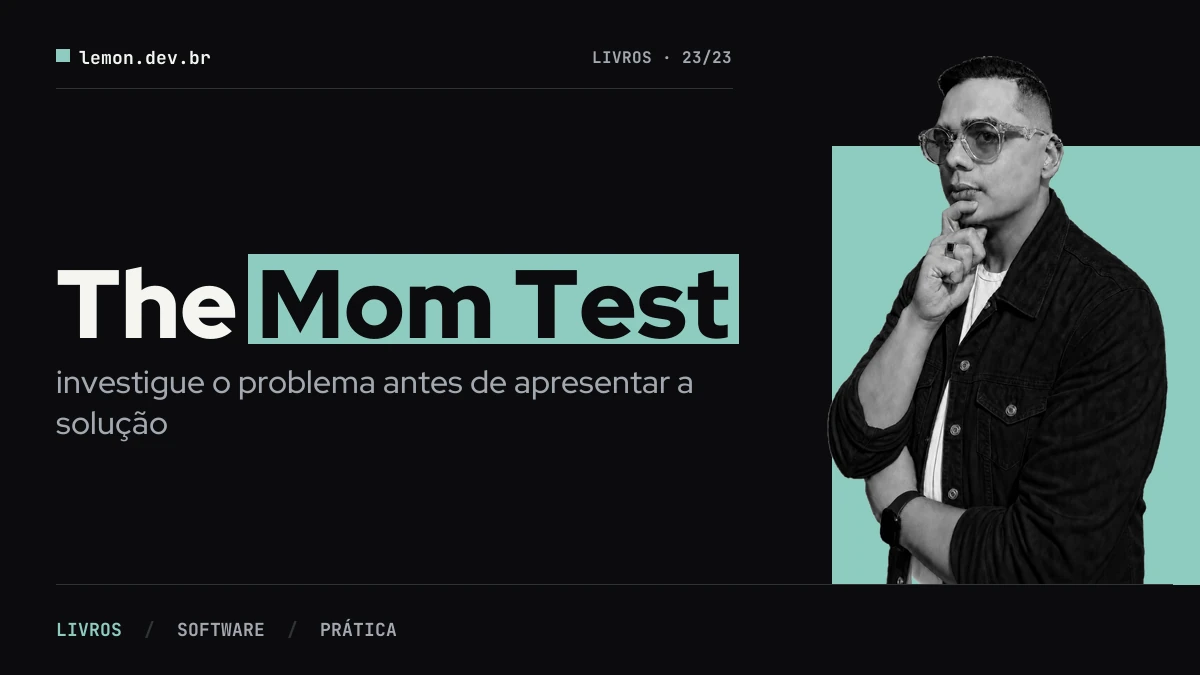
A team shows customers a new dashboard and asks whether it seems useful. People praise the screen, suggest filters and say they would like to try it. Months later, almost nobody changes their current process. The conversation was friendly, but it mixed courtesy with evidence. Rob Fitzpatrick’s The Mom Test teaches readers to reduce that mistake: ask about a person’s life and work, investigate episodes that already happened and seek facts that could change a decision.
The book is a short handbook for discovery conversations with people who need to understand customer problems and decisions before investing in a solution. Its thesis is not that customers deliberately lie; compliments, hypothetical questions and vague answers are often shaped by politeness, a desire to help and the difficulty of predicting one’s own behavior. The official site presents The Mom Test as a practical guide to getting useful learning from customer conversations, even when the idea does not exist yet (official book site).
Why read it: developers, designers and leaders often enter interviews with a solution already in mind. The book offers a simple method for postponing that pitch, hearing how work happens today and assessing whether a concrete, recurring and costly need deserves investment.
The first principle is to talk about the person’s life, not sell your idea. “Would you use a tool to automate reports?” asks the person to evaluate your proposal and imagine a future. “How did you prepare your last report?” invites them to reconstruct a specific situation. The first question produces an opinion about a concept; the second can reveal data sources, steps, delays, exceptions and who receives the result.
The second is to ask about concrete past behavior, not generic predictions. Instead of “Does this happen often?” ask for a recent example: when it happened, what they did, who was involved, what the consequence was and which alternative they tried. Detail does not guarantee perfect truth—memory and interpretation can fail too—but it leaves less room for an idealized answer. If someone cannot recall an episode, that is evidence for the hypothesis, not an invitation to offer hints until they say yes.
The third is to talk less and listen better. An interview is not a product demo, roadmap presentation or debate meant to convince someone. Short questions let people reveal their own sequence and vocabulary. When a team fills silence with explanations, it begins testing whether the interviewee can be agreeable, not whether the problem exists.
These rules also change note-taking. “The manager sent three spreadsheets to the team every Friday” is a reported fact; “she needs a centralized dashboard” is an interpretation; “the company will buy our product” is a business hypothesis. Keeping these levels separate protects the team from turning a convenient idea into a supposedly confirmed requirement. The distinction between problem, solution and purchase is one of the book’s most valuable contributions.
Fitzpatrick recommends looking for evidence stronger than praise. Someone might offer time for a follow-up, introduce the person who does the work, share an authorized example or participate in a test. Each commitment has a different cost and meaning. The team needs to ask what it demonstrates: access to a user, permission to observe a workflow, interest in learning or actual buying intent.
A commitment is not a sale either. The person experiencing the problem may not control the budget; the person approving the purchase may not do the work. In a company, users, buyers, security, legal and operations can have different goals. A useful conversation maps those relationships without pretending one interviewee represents the entire organization. Before requesting data, documents or introductions, explain the purpose, use, retention and who can access the material.
The book focuses on conversation quality, not a rigid script for every product stage. An interview can help discover what happens and why; when a problem is already well defined, it may also inform a validation decision. Fitzpatrick warns that interviews are not the right validation tool for every situation and that vague problems produce learning, not proof (“Customer convos are the carpenter’s hammer”). That caveat helps keep the book from becoming interview dogma.
Consider this hypothetical scenario: a software team is thinking about a service that generates a weekly incident report automatically. Before discussing a dashboard, it speaks with the people who prepare and use the report. Instead of asking “Would you like automatic reports?” it asks someone to describe the last one they prepared: which systems they consulted, how they matched identifiers, when they noticed missing data, who reviewed the document and how a decision followed from it.
The account might show that assembling the table takes little time; the delay comes from getting authorization to access logs in two systems. Another person might say the report rarely affects a decision and that the manual process is acceptable. The first finding suggests an access and governance dependency, not just text automation. The second questions whether the feature is worth building. Both are more valuable than a list of filters suggested by someone who saw an attractive screen.
The team separates notes into reported facts, open questions and interpretations. Then it compares conversations with people in different roles and, with consent, observes the process or examines an anonymized example. If the hypothesis is that manual review causes delays, a next step might measure production time in real cases. If the hypothesis is that a data source is missing, the team might test a narrow integration. In neither case can an interview alone estimate how many teams share the problem or prove they will buy the solution.
A useful follow-up is what the person has already tried and what it cost in time, money, risk or rework. “What happens if the report is late?” reveals impact better than “Is this important?” “Who has to approve a change to this workflow?” uncovers decision constraints. Questions like these help understand consequences without putting words in someone’s mouth. This example is an editorial application, not a story attributed to the book.
Free and paid products to turn ideas into a foundation you can actually ship.
13 products available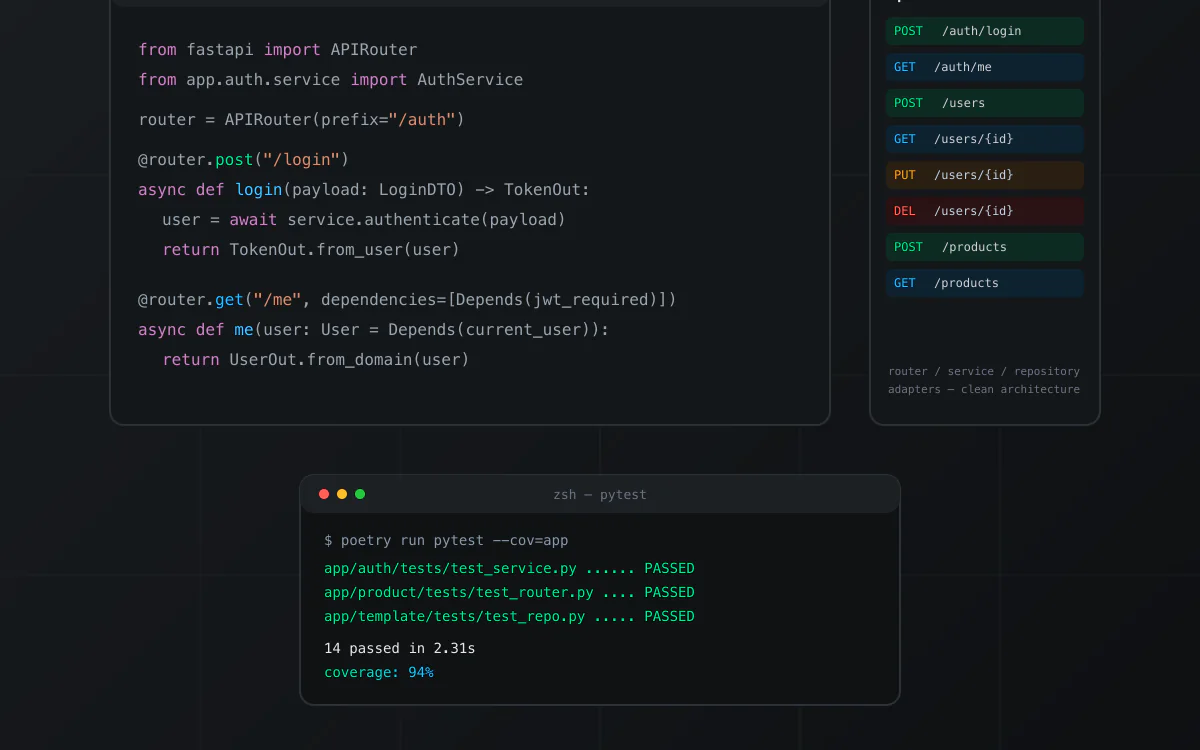
nextjs · boilerplate
Boilerplate de API em Python com FastAPI, organizado em Clean Architecture (router, service, repository e adapters por módulo). Inclui autenticação JWT com hashing bcrypt, MongoDB, testes com pytest e cobertura, Dockerfile e docker-compose para subir localmente, e documentação Swagger/OpenAPI automática. Repositório de origem privado; snapshot técnico verificado antes da publicação.
View product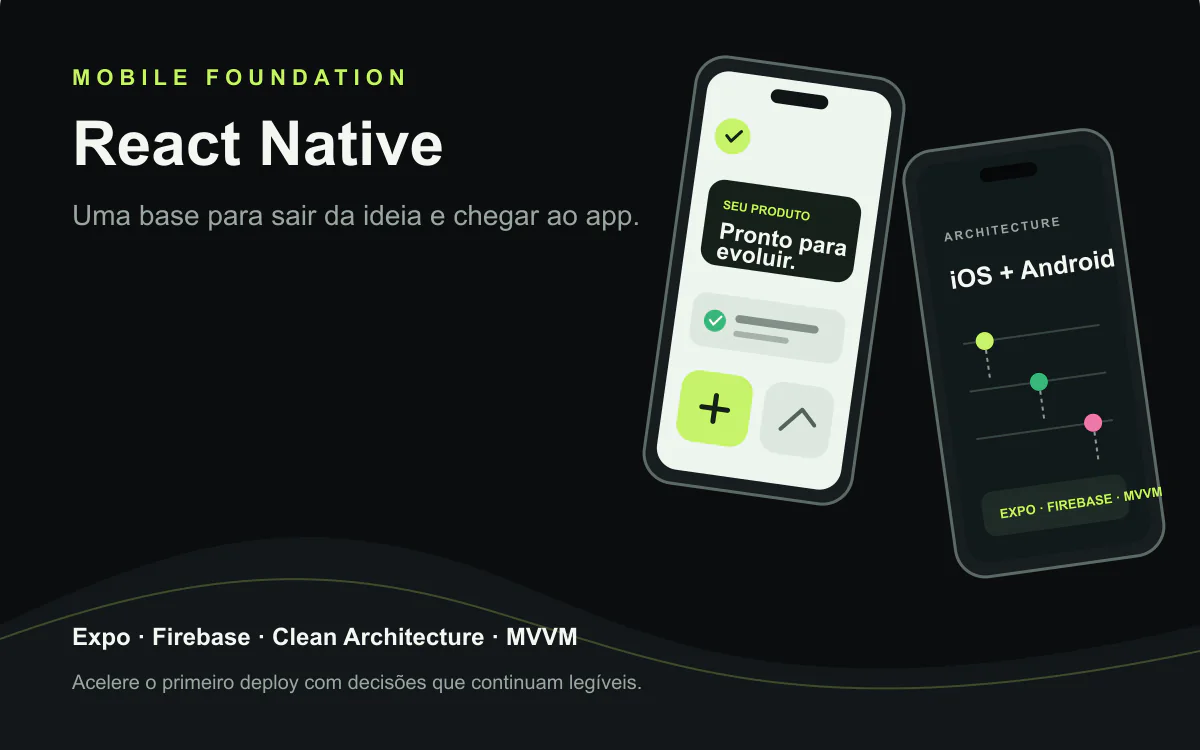
react · boilerplate
A React Native foundation for iOS and Android apps with Expo, Clean Architecture, MVVM, Firebase, and native modules. Technical reference from VaiDeFut, with public Google Play distribution and a documented iOS publishing flow.
View product
nextjs · boilerplate
A free open-source kit for getting started with coding agents across Claude Code, Codex, Gemini, Copilot, and OpenCode. The public repository confirms an MIT license.
View product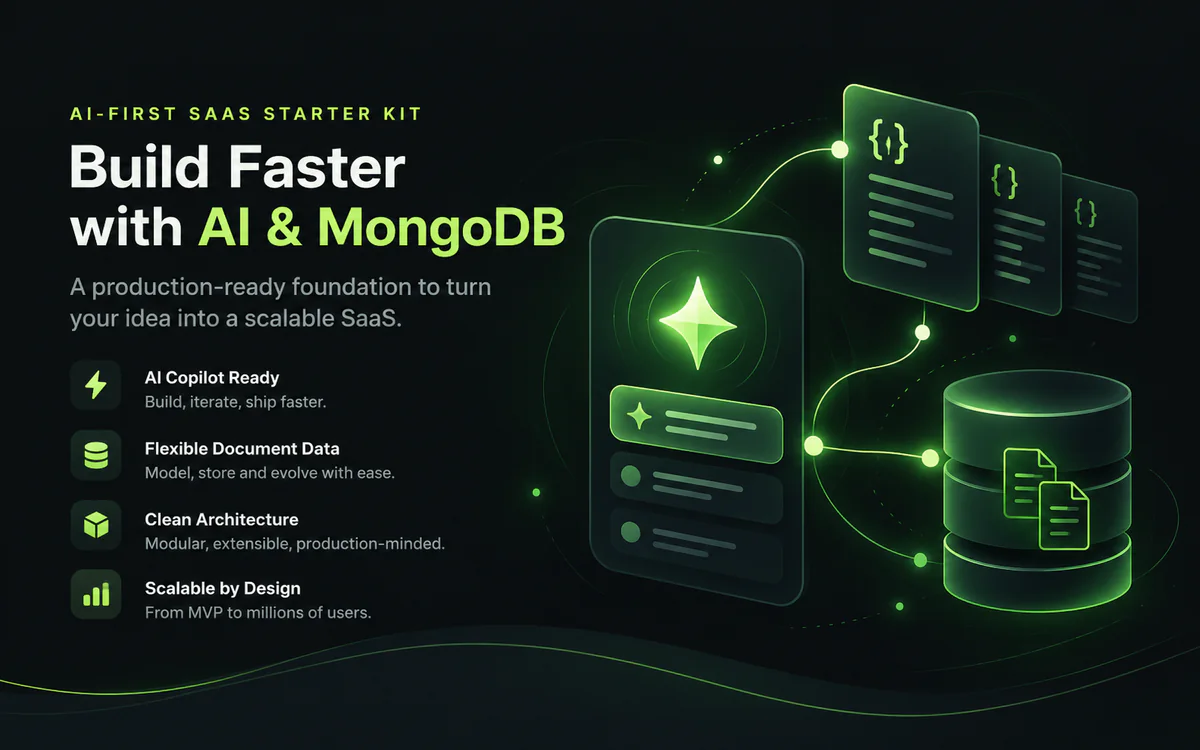
nextjs · boilerplate
A white-label AI-first foundation for shipping SaaS products with Next.js, chat, RAG, memory, tenants, and documentation. The verified snapshot documents Supabase rather than MongoDB; that limitation is explicit. MongoDB, Redis, and RabbitMQ require a compatible integration/configuration.
View product
nextjs · boilerplate
An advanced white-label, multi-tenant AI-first foundation for accelerating products with Next.js, chat, RAG, memory, and documentation. The verified snapshot does not prove a distinct Ultra layer; that limitation stays explicit while provider, cache, and queue swaps remain visible.
View product
nextjs · boilerplate
A white-label, multi-tenant foundation for turning an idea into an AI-first SaaS with Next.js, chat, RAG, memory, and documented security. The verified snapshot uses Supabase; the name identifies the source repository. Provider, cache, and queue boundaries stay explicit; Redis and RabbitMQ are configurable integrations.
View product
react · portfolio
A one-time contribution that supports free technical content, research, and the continuity of relevant projects published by Anderson Lima. You choose the amount; there is no subscription.
View product
react · boilerplate
A free React starter for building a reliable test suite from the first commit, combining Vitest, Testing Library, Playwright, Vite, TypeScript, Zustand, React Query, MirageJS, and PWA. The repository does not declare an SPDX license; review its terms before commercial use.
View product
react · portfolio
A public React, TypeScript, and Vite monorepo for exploring a component library with a native-inspired visual language. The current README is minimal and does not declare an SPDX license; treat it as a free preview.
View product
nextjs · saas
An AI-first SaaS boilerplate with Next.js, Supabase, Stripe, and provider routing to move from the first prompt toward a real deployment faster. AI, data, email, cache, and queue adaptations stay explicit; Redis and RabbitMQ are configurable integrations.
View product
react · saas
A React + TypeScript starter for multi-tenant SaaS with Firebase, Atomic Design, themes, PWA, product screens, MirageJS, and Gemini chat extensible to other providers. Validate production requirements, costs, and integrations before publishing.
View product
react · boilerplate
A public React starter with TypeScript, Zustand, React Query, Tailwind CSS, PWA, and documented AI integrations. The repository does not declare an SPDX license; review its terms before commercial use.
View product
nextjs · saas
A Next.js, TypeScript, and Tailwind CSS SaaS landing page with SEO, themes, i18n, PWA, and integration points for auth, Stripe, and AI. A clear foundation for leaving the blank screen behind and shaping your positioning.
View productContinue exploring similar topics
Apply Michael Nygard's approach to timeouts, isolation and recovery through a controlled failure exercise.
Turn passive study into a learning project with direct practice, feedback and spaced retrieval.

Use Frederick Brooks to inspect dependencies, integration and training before trying to recover a deadline by adding people.
A 47-point checklist to find bugs, security risks, and performance issues before launch.
Production-tested templates trusted by developers. Save weeks of setup on your next project.
Its main achievement is showing how small changes in wording alter the quality of information. “Would you do it?” becomes “When did you last do something similar?” “Does this bother you?” becomes “What happened the last time it failed?” “Would you pay?” becomes “How does your organization buy something like this, and who approves it?” These are not tricks for obtaining a desired answer; they reduce the chance of getting a socially comfortable one.
The book is pragmatic too. It helps people who code or lead technology enter a conversation without trying to prove their solution is right. A technical professional might discover that the problem is not in the code but in permissions, training, process, regulation or incentives. That can prevent months of implementation based on a false premise. The same applies inside a company: colleagues asking for a tool may be describing a symptom while the cause is dependencies, access or prioritization criteria.
Another strength is encouraging teams to record contradictions and bad news. If recent conversations do not support a premise, confidence in the hypothesis should fall. An interview is not for collecting pitch-friendly quotes; it is for choosing the next test. The author, who describes himself as a programmer pushed into customer-facing work, builds the handbook around that tension between technical thinking and customer conversations (about Rob Fitzpatrick).
The subtitle’s “everyone is lying” is provocative, but it can invite a cynical reading. Many people are not lying: they are trying to help, avoid disappointing someone or predict behavior they do not understand. They can also forget details, reinterpret the past through a current solution or talk about a problem that seems acceptable to an interviewer. The responsibility is not to “catch” the customer; it is to ask questions, create context and obtain consent in ways that reduce bias and respect the person.
Accounts do not quantify prevalence. Five convincing conversations do not prove a need is common or that a segment can sustain a product. People who accept an interview may be more interested, available or connected to the team than people who decline. An easy-to-reach sample may leave out people with less power, connectivity, time or safety to disagree. Researchers should record how participants were recruited and which perspectives are missing.
There is also a risk of overvaluing what people say while observing too little of what they do. Past accounts are more concrete than predictions, but they remain accounts. When appropriate, supplement conversations with workflow observation, operational data, prototypes, usability tasks, experiments or purchase records. Each method answers a different question. For an interface, an interview can expose context; a usability test can show where someone gets lost; telemetry can estimate frequency. None replaces all the others.
The book does not eliminate solution discovery. After understanding a need, a team still has to propose alternatives, observe whether people can use one and measure whether the outcome improves. The absence of an immediate purchase can have many causes—budget, timing, security or a priority change—and a verbal yes does not predict adoption either. Commitments are graduated signals, not guarantees.
In B2B software, the user experiencing the pain may lack authority to try a solution. Asking for an introduction to a buyer can pressure a professional relationship; requesting incident samples can expose confidential information. Internal interviews can also confuse research with performance evaluation. Be clear about the purpose, ask only for what is needed and do not promise that every request will be implemented. A discovery process is only good if it respects the people it depends on.
Before scheduling conversations, write the decision you are trying to make and the assumption most likely to change it. It might be “the delay comes from reconciling data manually” or “teams need a new way to get access.” Recruit people who do, approve and receive the work, not only familiar contacts who want to help. Do not reveal the solution in the invitation if that would steer who accepts.
In the conversation, ask for a recent episode and follow its sequence: what happened, what the person did, which tools they used, who was involved, what it cost and what they tried next. Ask about exceptions and failures, not just the normal path. Avoid requesting opinions about hypothetical features until you understand the work. If a prototype is necessary, separate reaction from evidence: observe what the person can do and what result they get.
Afterward, label every note as a reported fact, direct observation, interpretation or hypothesis. Compare similarities and contradictions across roles, record sample limits and decide which evidence is missing. A next step could be observing a workflow, checking logs, seeking authorization for a small test or abandoning the hypothesis. If nothing could change the decision because the team has already chosen the solution, the conversation is a presentation, not discovery.
The Mom Test is useful for founders, engineers, product managers, designers and researchers who need to reduce uncertainty about problems before building. It is especially practical for technical professionals who can reach customers but have not been trained in discovery or sales. Its short format makes it easy to prepare for an interview the same day and review questions with a team.
It is insufficient as a complete manual for research, strategy, design or quantitative validation. Pair it with observation and experiments, and combine it with Hooked only after the need is understood and the next question is whether recurring use delivers value. The Mom Test helps determine whether a problem deserves attention; it does not provide the product answer on its own.
Verdict: a short, useful and direct book about replacing compliments with learning that can change a plan. Its central advice remains valuable: ask about real work before presenting your solution. The main caution is not to mistake a good interview for enough market evidence. Use conversations to discover and frame hypotheses; triangulate before building and keep measuring afterward.