


Anderson LimaSoftware Engineer & Architect
October 24, 2026
10 min read
0 views

A learning app sends a reminder. Someone opens it, answers a question and gets an explanation that helps them remember a concept. In this case, returning may support a goal they chose. Now imagine the same notification leading to an empty screen, a threatened daily streak and no visible progress. The open still counts as engagement, but it does not show that the product helped. That distinction guides this reading of Hooked, by Nir Eyal with Ryan Hoover: designing a return is one capability; justifying why someone should return is another.
First published in 2014, the book presents the Hook Model as a four-stage cycle—trigger, action, variable reward and investment—for explaining how products can connect a need with recurring use. The publisher describes the revised edition as a practical guide with a new case study; the author maintains additional material and examples on his site (Penguin Random House, Nir Eyal).
Why read it: the model provides concrete language for mapping what happens between a need and a later use. It is especially useful when a team treats any increase in clicks as success or designs notifications before understanding the problem they are supposed to solve.
A trigger starts the sequence. It can be external—a reminder, invitation or action in another product—or internal, tied to a situation and emotional state. The design question is not only “What notification should we send?” but “What is the person trying to do when they feel the need to use this product?” An external trigger can remind someone when they chose to study; it should not assume that every quiet moment is an opportunity to capture attention.
An action is the simple behavior someone performs in anticipation of a reward. Fewer steps can help when they remove accidental effort, but simplicity depends on comprehension, ability and context. A single button that publishes sensitive data may be easy to tap and still be a poor interaction. Friction sometimes protects a decision: confirming a transfer or explaining the consequences of deletion is not automatically an experience failure.
A variable reward introduces uncertainty about what follows an action. In the book, variation may involve discoveries, social responses or a sense of progress; it does not mean every result should be unpredictable. A list of results might surface a relevant discovery. A payment screen, diagnosis or password-recovery flow should be predictable and dependable. Variability is a motivation hypothesis, not a blanket justification for infinite feeds, urgent notifications or loot boxes.
Finally, an investment is something a person puts into a product that may increase its later value: content, preferences, history or effort spent configuring a routine. It does not have to be money. A study app might retain topics already mastered to choose future reviews. That data represents value only if it improves the next experience and people understand how it will be used; accumulating effort to make leaving painful turns investment into a switching cost.
The cycle helps locate gaps. A notification without a clear action interrupts; an action without a useful return disappoints; a reward unrelated to a need may only distract; an investment with no future benefit needs an explanation. Eyal presents the example of a meeting-preparation application where personal notes could improve later use (Hooked case study). The model organizes this analysis, but cannot establish by itself that the need exists or that repetition is healthy.
Consider an app that helps people practice SQL queries. The user’s chosen intention is to review concepts that come up at work, not to open the app daily for a colorful streak. During setup, someone chooses a topic, selects possible days and times, and can skip a week. These settings are useful investments: they inform future sessions without creating a moral debt for taking a break.
At a chosen time, the trigger is a configurable reminder. The action is to answer a short query without looking at the solution. The reward is informative feedback: the answer runs, an explanation identifies the cause of an error, and the next challenge adapts to what the person demonstrated. Variation lies in which examples and challenges help that person; it does not hide whether an answer was correct, create false scarcity or punish a missed day. Later, a record of errors can select future reviews, with an option to delete the data.
To evaluate the cycle, the team should define the outcome before optimizing return. A reasonable hypothesis might be: “Reminders at times chosen by users increase the share of people who complete a review and can apply the concept in a different exercise.” The team could compare a baseline period with a version offering configurable times, looking at completion, performance on a transfer task and requests to disable notifications. That comparison should account for differences between groups and content changes; an increase in sessions alone does not settle the question.
This is an editorial example, not a research result or a claim from the book. It shows the model’s practical value: instead of asking “How do we make the routine more addictive?” the team identifies the sequence, states the benefit and defines signals that could invalidate the proposal. If people ignore the review, perhaps they need better examples, more time, another interface or no reminder at all. The mechanism should not replace conversation and problem discovery.
Free and paid products to turn ideas into a foundation you can actually ship.
13 products available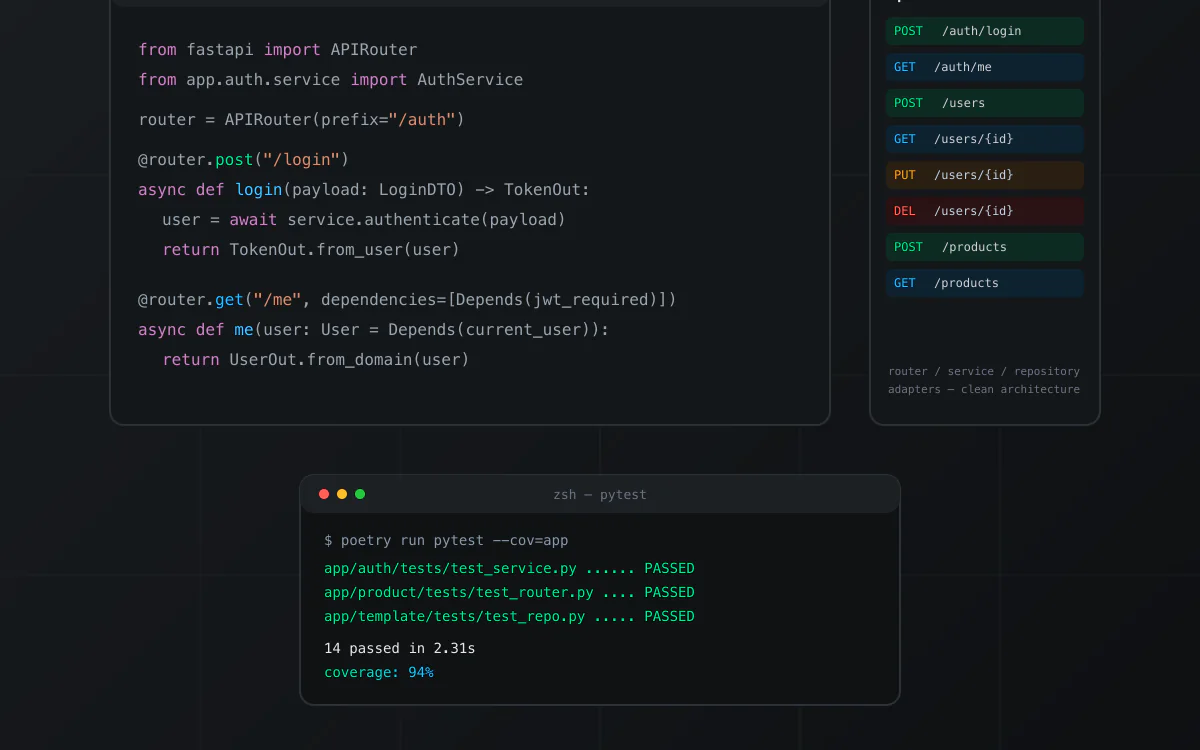
nextjs · boilerplate
Boilerplate de API em Python com FastAPI, organizado em Clean Architecture (router, service, repository e adapters por módulo). Inclui autenticação JWT com hashing bcrypt, MongoDB, testes com pytest e cobertura, Dockerfile e docker-compose para subir localmente, e documentação Swagger/OpenAPI automática. Repositório de origem privado; snapshot técnico verificado antes da publicação.
View product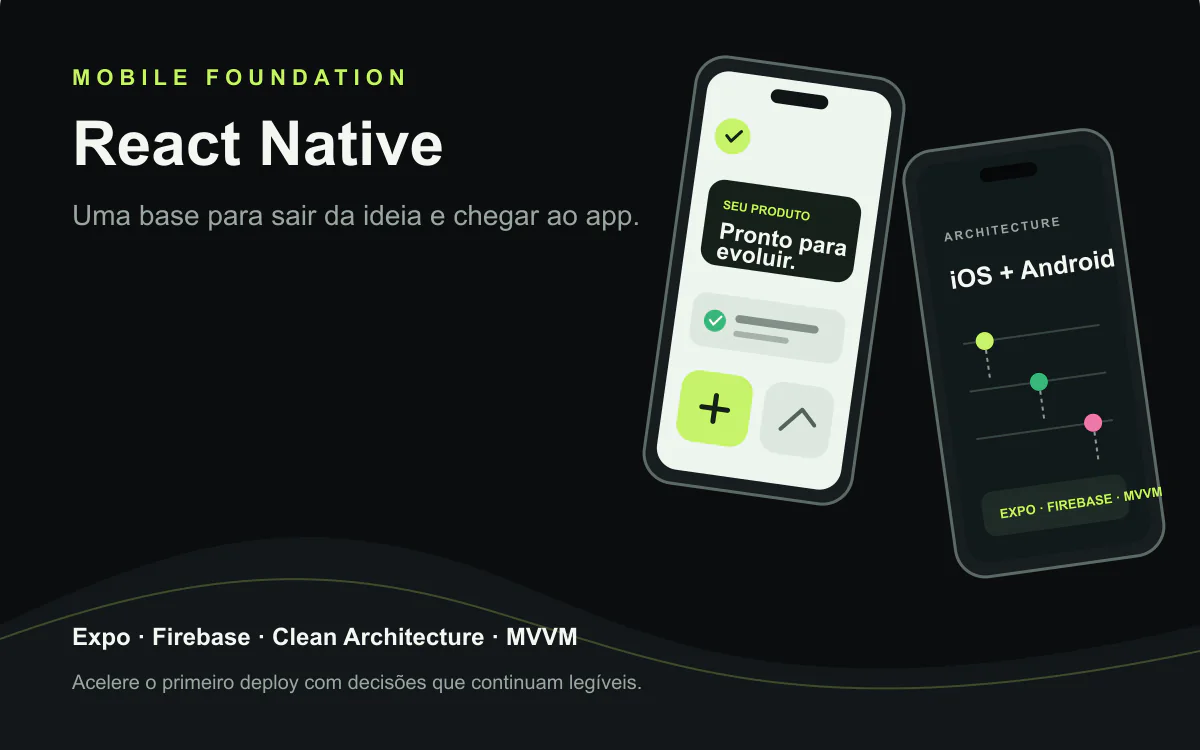
react · boilerplate
A React Native foundation for iOS and Android apps with Expo, Clean Architecture, MVVM, Firebase, and native modules. Technical reference from VaiDeFut, with public Google Play distribution and a documented iOS publishing flow.
View product
nextjs · boilerplate
A free open-source kit for getting started with coding agents across Claude Code, Codex, Gemini, Copilot, and OpenCode. The public repository confirms an MIT license.
View product
nextjs · boilerplate
A white-label AI-first foundation for shipping SaaS products with Next.js, chat, RAG, memory, tenants, and documentation. The verified snapshot documents Supabase rather than MongoDB; that limitation is explicit. MongoDB, Redis, and RabbitMQ require a compatible integration/configuration.
View product
nextjs · boilerplate
An advanced white-label, multi-tenant AI-first foundation for accelerating products with Next.js, chat, RAG, memory, and documentation. The verified snapshot does not prove a distinct Ultra layer; that limitation stays explicit while provider, cache, and queue swaps remain visible.
View product
nextjs · boilerplate
A white-label, multi-tenant foundation for turning an idea into an AI-first SaaS with Next.js, chat, RAG, memory, and documented security. The verified snapshot uses Supabase; the name identifies the source repository. Provider, cache, and queue boundaries stay explicit; Redis and RabbitMQ are configurable integrations.
View product
react · portfolio
A one-time contribution that supports free technical content, research, and the continuity of relevant projects published by Anderson Lima. You choose the amount; there is no subscription.
View product
react · boilerplate
A free React starter for building a reliable test suite from the first commit, combining Vitest, Testing Library, Playwright, Vite, TypeScript, Zustand, React Query, MirageJS, and PWA. The repository does not declare an SPDX license; review its terms before commercial use.
View product
react · portfolio
A public React, TypeScript, and Vite monorepo for exploring a component library with a native-inspired visual language. The current README is minimal and does not declare an SPDX license; treat it as a free preview.
View product
nextjs · saas
An AI-first SaaS boilerplate with Next.js, Supabase, Stripe, and provider routing to move from the first prompt toward a real deployment faster. AI, data, email, cache, and queue adaptations stay explicit; Redis and RabbitMQ are configurable integrations.
View product
react · saas
A React + TypeScript starter for multi-tenant SaaS with Firebase, Atomic Design, themes, PWA, product screens, MirageJS, and Gemini chat extensible to other providers. Validate production requirements, costs, and integrations before publishing.
View product
react · boilerplate
A public React starter with TypeScript, Zustand, React Query, Tailwind CSS, PWA, and documented AI integrations. The repository does not declare an SPDX license; review its terms before commercial use.
View product
nextjs · saas
A Next.js, TypeScript, and Tailwind CSS SaaS landing page with SEO, themes, i18n, PWA, and integration points for auth, Stripe, and AI. A clear foundation for leaving the blank screen behind and shaping your positioning.
View productContinue exploring similar topics

Critical review of Rob Fitzpatrick: investigate real episodes, separate facts from hypotheses and do not mistake interviews for market validation.

Apply Michael Nygard's approach to timeouts, isolation and recovery through a controlled failure exercise.

Turn passive study into a learning project with direct practice, feedback and spaced retrieval.
A 47-point checklist to find bugs, security risks, and performance issues before launch.
Production-tested templates trusted by developers. Save weeks of setup on your next project.
Hooked is short, easy to discuss in product teams and useful for building a shared map across design, engineering and business. Rather than implying that retention comes from one feature, it asks teams to consider the entire cycle: what starts the behavior, what action costs, what value appears and what makes later use better. The investment concept also draws attention to data and effort users contribute, sometimes without realizing these inputs will shape future experiences.
The book includes an explicit ethical reflection tool, the “Manipulation Matrix,” which combines two questions: does the product materially improve the life of someone using it, and would its maker use it too? (Eyal’s essay about the matrix). That is better than treating ethics as a sign-off step at the end of a project. It can open a discussion about the team’s intent, the promised benefit and the distance between decision-makers and the people bearing the cost of interruptions.
For technology practitioners, another contribution is making behavior part of the engineering problem. A feature can work as implemented and still fail within the cycle: a reminder arrives at the wrong time, saved state does not improve the next session, preferences cannot be changed or a return leads to an action without purpose. This lens connects instrumentation and implementation to product work without pretending the book is an architecture manual or a user-research course.
The main limitation is the temptation to read the cycle as a sufficient formula. Case studies show how the author and companies interpret product mechanisms; they do not prove that the four stages are necessary, explain all retention or create value for every audience. Successful examples have survivorship bias: we see products that grew and retrospective narratives organizing their steps, but rarely comparable detail about attempts that used similar structures and failed.
The book also draws on a different digital landscape. The revised edition adds a case study, but products, platform policies, privacy expectations and recommendation systems change. Readers should use the framework to generate questions, not copy the notifications, feeds or mechanisms of companies discussed. A pattern that once seemed efficient may now depend on excessive data collection, surveillance or distribution rules the team does not control.
“Variable reward” is the concept easiest to turn into a poor justification. If a team measures only returns, variability can prompt repeated checking even when someone does not complete the task. Unwanted notifications, streak counters and difficult cancellation can raise frequency while eroding trust. The book gives designers mechanisms of influence, so anyone recommending it should also discuss consent, transparency, exit options and the unequal distribution of harm. Engagement is not synonymous with compulsion, but teams should not treat those terms as interchangeable to avoid examining consequences.
The ethical matrix is a starting point, not a seal of approval. The fact that a maker uses the product does not prove it benefits every audience. Believing a product improves people’s lives is not a substitute for evidence, consent or impact analysis for vulnerable groups. A financial app can help some users and pressure others to spend; a messaging tool can be useful while creating expectations of constant availability. The decision requires listening to users, reviewing business incentives and allowing people to challenge or leave the product.
Finally, the model says more about return than about discovering what to build. Interviews, observation and problem tests are needed to find a need; The Mom Test helps ask questions that reduce vague praise and seek evidence from past behavior. Only then does it make sense to ask whether a recurring-use cycle supports that outcome. Confusing discovery with retention can lead teams to optimize an imagined need.
Choose a recurring feature and write its cycle in four lines, without marketing language: situation or trigger; observable action; delivered reward; investment that improves a future session. For each line, note what evidence supports the hypothesis and what else could explain the behavior. If the trigger is a notification, for example, opening may mean someone found value—or that they worried about a message they could not safely ignore.
Next, state the user’s intention in one sentence and the primary measure that approximates it. “Increase retention” is a business objective, not proof of benefit. A product outcome might be helping someone complete a chosen review or reducing the time needed to find a report used in a decision. Track that measure alongside costs: disabled notifications, errors, repeated attempts, cancellations and complaints. Do not select harm metrics only after the numbers look bad.
Test the smallest mechanism that can answer a question. Let people choose the time and frequency, explain why data is being stored and provide an accessible way to delete or export it. Agree in advance on a stop condition for adverse results. Then talk to people who received the experience, including those who ignored or disabled it. If there is no verifiable improvement in the chosen outcome, remove the mechanism or return to discovery.
Read Hooked if you work with digital products, onboarding, notifications, learning or recurring-use flows and need language for examining these mechanisms with a team. The visual cycle makes workshops and feature reviews more concrete. Managers and engineers can also use it to question whether instrumentation records user success or only activity convenient to the business.
It is less suitable as a standalone manual for proving demand, conducting research, estimating causal effects or deciding what is ethical. Combine it with qualitative discovery, outcome analysis and a review of consent and harms. Read Indistractable next if the question is how people preserve their own intentions in an environment full of triggers; the books observe different sides of the attention contest.
Verdict: Hooked offers a concise, usable map of return mechanisms and an explicit invitation to discuss intent. The framework is valuable when it helps a team explain benefits and identify costs; it becomes dangerous when retention turns into an end in itself. It is worth reading if you build products, provided each proposed cycle comes with a harder question: what outcome did the person choose, what evidence confirms it, and what signal would make the team stop?