


Anderson LimaSoftware Engineer & Architect
October 24, 2026
9 min read
0 views

A payment SDK update forces you to edit a discount rule. The supplier renamed a response field, yet the change spreads through controllers, calculations and business tests. Your team is paying for a dependency that once looked convenient. Elsewhere, six layers separate an administrative screen from a single UPDATE, and the same team is paying for abstractions that protect nothing yet.
Clean Architecture helps explain the first situation. Applying it well also requires confronting the second. I recommend reading the book as a proposal for controlling how changes spread, while accounting for the price of every boundary. A design earns its place when you can explain which decision remains protected after a plausible change.
This review covers Clean Architecture: A Craftsman's Guide to Software Structure and Design, by Robert C. Martin, first edition, published in 2017, ISBN 9780134494166. The catalog lists a 2018 copyright. Its progression covers programming paradigms, design principles, components and architecture, including use cases, boundaries and a video-sales case study. Bibliographic details and the outline appear on the official Pearson/InformIT page.
That breadth explains both the value and the demands of the reading. A reader seeking a folder-structure tutorial will encounter a wider discussion of design decisions. My assessment is favorable for developers who have experienced changes spreading across modules, provided they test the arguments against a concrete system. Memorizing principle names offers little help when the difficult decision is where to accept coupling.
In the author's essay preceding the book, policies occupy the interior of the model while mechanisms such as interfaces and persistence sit outside. There is also a distinction between more general rules associated with entities and application-specific coordination associated with use cases.
Consider renewing a subscription. Eligibility for a discount might belong to the commercial contract. Loading that contract, applying the decision and requesting payment form an application workflow. Serializing the request for an SDK belongs to the integration. The separation becomes useful when the reasons for change differ: a new commercial benefit should allow the supplier translation to remain intact, while an SDK update should allow eligibility rules to remain intact.
Working out that distinction requires conversations with people who understand the business. A class called Entity does not make the model correct. If renewal extends access before confirmation for one product and after settlement for another, the contracts need to express the difference. Architecture organizes knowledge the team can articulate; it cannot discover the commercial policy on the team's behalf.
The official explanation of the dependency rule concerns references in source code: they should point toward inner policies. A use case can therefore know a payment contract owned by the application, while an external adapter implements it. At runtime, the use case still calls that adapter.
The following original diagram shows both views. The use case, port and adapter belong to one process; the arrow from the adapter to the payment API represents an external integration.
Ownership of the port is the decisive detail. If application code receives an SDK object and reads its fields, naming an interface has not removed the coupling. A contract expressed through amount, currency and operation identity leaves translation in the adapter. Choosing the concrete adapter can happen in application composition near startup.
Inspect imports and the types crossing the boundary. The rule is stronger than a folder convention because it describes a relationship the team can check. Passing an import check still establishes only that structural property. Correctly directed dependencies can coexist with a use case that calculates the wrong renewal amount. The architecture needs behavioral evidence as well.
Free and paid products to turn ideas into a foundation you can actually ship.
13 products available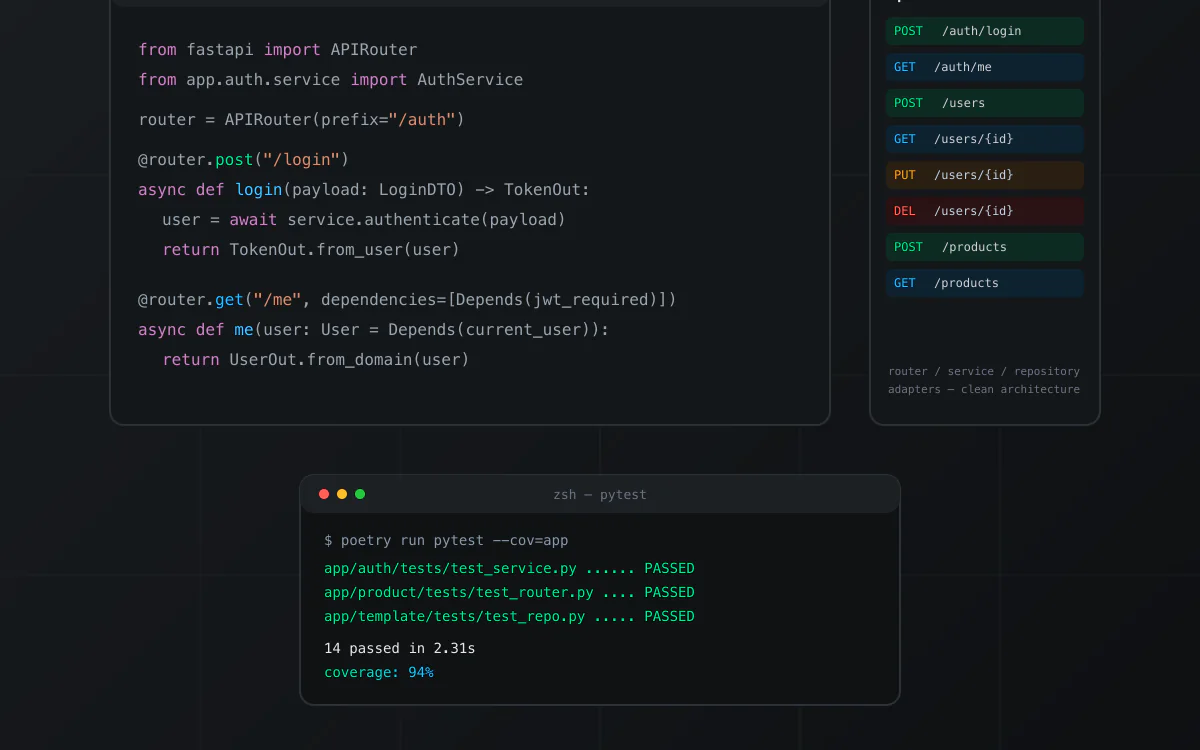
nextjs · boilerplate
Boilerplate de API em Python com FastAPI, organizado em Clean Architecture (router, service, repository e adapters por módulo). Inclui autenticação JWT com hashing bcrypt, MongoDB, testes com pytest e cobertura, Dockerfile e docker-compose para subir localmente, e documentação Swagger/OpenAPI automática. Repositório de origem privado; snapshot técnico verificado antes da publicação.
View product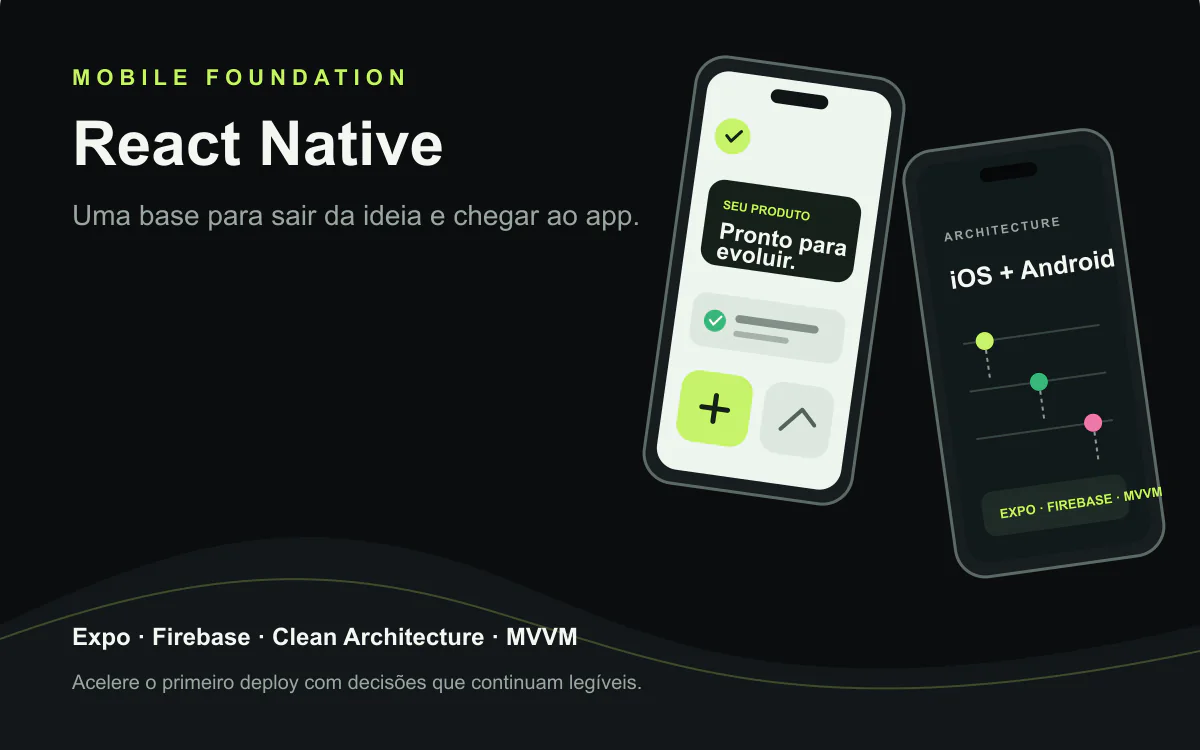
react · boilerplate
A React Native foundation for iOS and Android apps with Expo, Clean Architecture, MVVM, Firebase, and native modules. Technical reference from VaiDeFut, with public Google Play distribution and a documented iOS publishing flow.
View product
nextjs · boilerplate
A free open-source kit for getting started with coding agents across Claude Code, Codex, Gemini, Copilot, and OpenCode. The public repository confirms an MIT license.
View product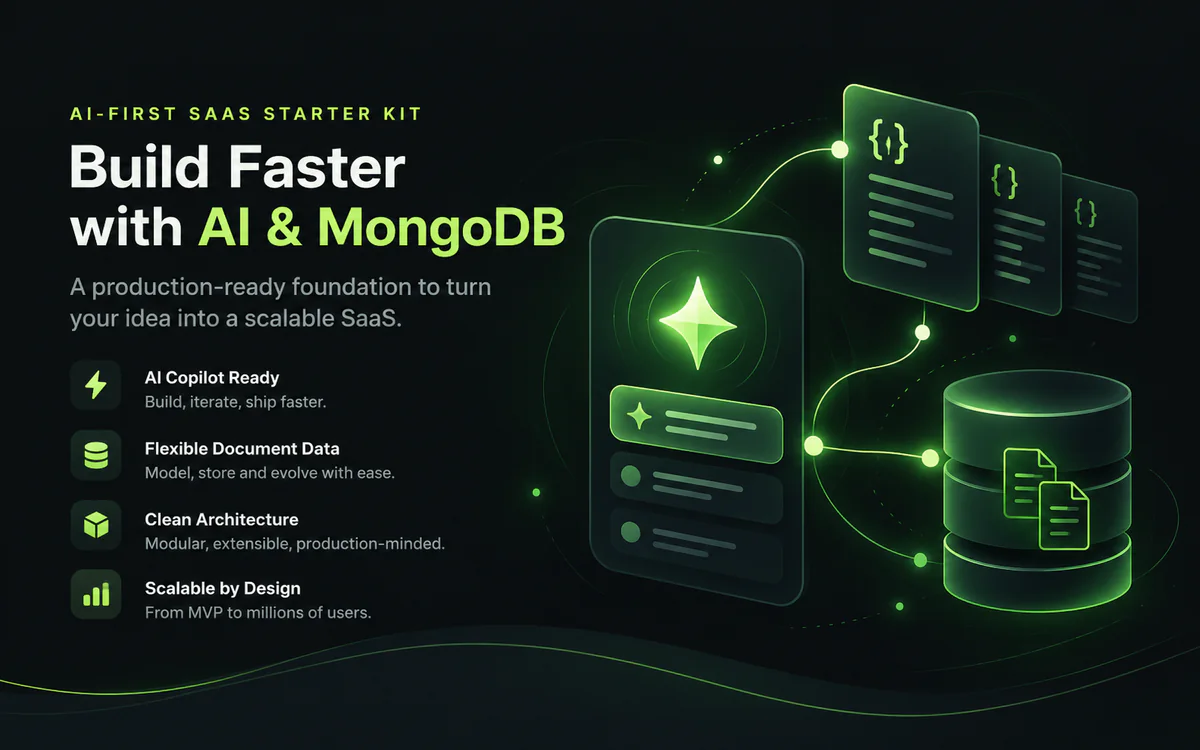
nextjs · boilerplate
A white-label AI-first foundation for shipping SaaS products with Next.js, chat, RAG, memory, tenants, and documentation. The verified snapshot documents Supabase rather than MongoDB; that limitation is explicit. MongoDB, Redis, and RabbitMQ require a compatible integration/configuration.
View product
nextjs · boilerplate
An advanced white-label, multi-tenant AI-first foundation for accelerating products with Next.js, chat, RAG, memory, and documentation. The verified snapshot does not prove a distinct Ultra layer; that limitation stays explicit while provider, cache, and queue swaps remain visible.
View product
nextjs · boilerplate
A white-label, multi-tenant foundation for turning an idea into an AI-first SaaS with Next.js, chat, RAG, memory, and documented security. The verified snapshot uses Supabase; the name identifies the source repository. Provider, cache, and queue boundaries stay explicit; Redis and RabbitMQ are configurable integrations.
View product
react · portfolio
A one-time contribution that supports free technical content, research, and the continuity of relevant projects published by Anderson Lima. You choose the amount; there is no subscription.
View product
react · boilerplate
A free React starter for building a reliable test suite from the first commit, combining Vitest, Testing Library, Playwright, Vite, TypeScript, Zustand, React Query, MirageJS, and PWA. The repository does not declare an SPDX license; review its terms before commercial use.
View product
react · portfolio
A public React, TypeScript, and Vite monorepo for exploring a component library with a native-inspired visual language. The current README is minimal and does not declare an SPDX license; treat it as a free preview.
View product
nextjs · saas
An AI-first SaaS boilerplate with Next.js, Supabase, Stripe, and provider routing to move from the first prompt toward a real deployment faster. AI, data, email, cache, and queue adaptations stay explicit; Redis and RabbitMQ are configurable integrations.
View product
react · saas
A React + TypeScript starter for multi-tenant SaaS with Firebase, Atomic Design, themes, PWA, product screens, MirageJS, and Gemini chat extensible to other providers. Validate production requirements, costs, and integrations before publishing.
View product
react · boilerplate
A public React starter with TypeScript, Zustand, React Query, Tailwind CSS, PWA, and documented AI integrations. The repository does not declare an SPDX license; review its terms before commercial use.
View product
nextjs · saas
A Next.js, TypeScript, and Tailwind CSS SaaS landing page with SEO, themes, i18n, PWA, and integration points for auth, Stripe, and AI. A clear foundation for leaving the blank screen behind and shaping your positioning.
View productContinue exploring similar topics

Apply Michael Nygard's approach to timeouts, isolation and recovery through a controlled failure exercise.

Turn passive study into a learning project with direct practice, feedback and spaced retrieval.

Critical review of Rob Fitzpatrick: investigate real episodes, separate facts from hypotheses and do not mistake interviews for market validation.
A 47-point checklist to find bugs, security risks, and performance issues before launch.
Production-tested templates trusted by developers. Save weeks of setup on your next project.
This teaching scenario is original. A fictional subscription costs 10,000 cents per renewal. An eligible contract receives a 10% discount, resulting in a 9,000-cent payment in BRL. A contract without the benefit pays 10,000 cents. Taxes and fractional rounding are outside this example so that the analysis can concentrate on the boundary.
The use case receives a subscription identifier and a stable operation identifier. It retrieves the necessary information, checks eligibility and requests payment. The port can return a result expressed in the application's vocabulary: confirmed, declined or unknown. The adapter translates supplier responses into those results without independently deciding whether the customer should lose access.
Now consider three separate changes:
| Scenario change | Expected result | Area that should need modification |
|---|---|---|
| SDK renames its payment-identifier field | Eligible payment remains 9,000 cents | Adapter translation and tests |
| Discount increases from 10% to 15% | Eligible payment becomes 8,500 cents | Policy and its tests |
| A new interface initiates the same renewal | Amount and eligibility remain unchanged | Input and presentation |
This table provides a way to assess the book's recommendation. If the SDK update still requires editing eligibility examples, the boundary leaks. If changing the discount requires adjusting a technical-field mapping, responsibilities may be mixed. There is no promise that every change stays isolated: a new commercial obligation might require information the current integration cannot provide.
The unknown result deserves particular attention. A timeout can happen after the provider accepts a payment. Converting every exception into "declined" could allow the application to repeat the charge under a new operation identifier. In this scenario, the team would need explicit idempotency, later status checks and reconciliation. A port helps make the decision visible, but cannot remove uncertainty from an external operation.
Tests using an in-memory adapter would check the requested amount and how the use case handles those outcomes. Contract tests would check translation through the real adapter. Neither alone proves bank settlement or prevents concurrent renewal attempts. That gap should shape integration and persistence validation before this example influences production code.
The scenario also shows why a generic save or execute interface can be too weak. If the application needs an operation identity and an ambiguous outcome, hiding them behind a generic success flag erases the information needed for safe recovery. A useful boundary preserves relevant constraints even when doing so makes its signature less tidy.
An interface, two data models and repeated mapping create maintenance work whenever a field changes. For a simple internal screen with one store and little business logic, directly using framework facilities can be an economical choice. The team accepts that relationship to deliver a small operation with fewer concepts to maintain.
The book itself acknowledges isolation costs. The opening of Partial Boundaries discusses complete boundaries that are expensive to implement and maintain, alongside the possibility of preparing only part of one. That complicates the interpretation that every project requires an identical collection of layers and objects.
I would start with a business calculation that already needs independent understanding. It can be an ordinary function without HTTP or ORM references. An unstable integration can acquire an adapter when there is a concrete reason. I would not create a generic repository for every table merely to make the design symmetrical. An abstraction exposing every peculiarity of the database preserves the cost of coupling and adds costs of its own.
Code decoupling and distribution also need separate decisions. A monolith can enforce boundaries through modules. Splitting processes introduces network contracts, deployment concerns and partial failures, which require an operational justification. Those benefits do not appear simply because a team turns diagram arrows into HTTP requests.
My main reservation is that independence can sound broader than it really is. A model without database imports must still persist invariants safely. Indexes, transaction isolation, concurrency and data shape can influence the solution. Calling the database a detail expresses a desired position in the dependency structure; it does not diminish its operational importance.
The team will also need to decide how the rule survives everyday work. If every module can import everything, protection depends on continuous manual review. Import constraints, package visibility or module separation may help, depending on the language. Someone must own those checks, define allowed exceptions and make violations visible as work to address. A drawing does not supply that enforcement.
Another difficulty is deciding what should stay stable. During product discovery, commercial rules may change more often than the framework. Building several interfaces around an incorrect model can harden assumptions prematurely. I would ask for a short written justification for each boundary: which change it should contain, what cost it introduces and when it will be reconsidered. That makes the recommendation open to scrutiny without requiring allegiance to a style.
Developers who understand functions, modules, interfaces and tests have the necessary foundation. The book will probably be more useful after maintaining an application with a database and external integrations. A supplier replacement or a business rule duplicated across channels provides concrete material for examining its arguments. An architect title is unnecessary.
I would postpone a complete reading for someone still learning to build a small application. Implement a workflow, test a rule and observe how a change spreads first. Experienced readers seeking capacity planning, distributed operations or detailed database design will also need specific references for those decisions. This book offers a structural perspective; I would not treat it as a complete architecture education.
Within the series, Clean Code helps examine code inside the boundaries. I would place Domain-Driven Design alongside this book when the team disagrees about what contract, renewal or payment means. A Philosophy of Software Design supplies a useful contrasting question: does the new interface hide complexity, or make every caller understand more details? Comparing those perspectives asks more of the reader, but produces more specific recommendations.
Choose a recently changed workflow. Draw its code references, then draw its execution calls separately. Mark infrastructure types reaching business rules and identify the external effect that would be most expensive to repeat accidentally. Before extracting anything, write down the outcomes that existing tests must preserve.
Try a small change, such as separating SDK-response translation. Simulate a change in the external format while preserving business behavior, and record which contracts need modification. Then change a policy and observe whether the work moves to the expected area. Include extra mapping and navigation effort in the record because those costs belong in the evaluation too.
My verdict is to recommend Clean Architecture to developers seeking more precise arguments for boundaries. It offers a strong criterion for discussing dependencies and makes ownership of important contracts explicit. Applying it requires deciding how much isolation is worth buying in each context. A useful reading leads to less unnecessary propagation of changes and an honest explanation of the dependencies the team chooses to retain.