

Anderson LimaSoftware Engineer & Architect
October 24, 2026
9 min read
0 views
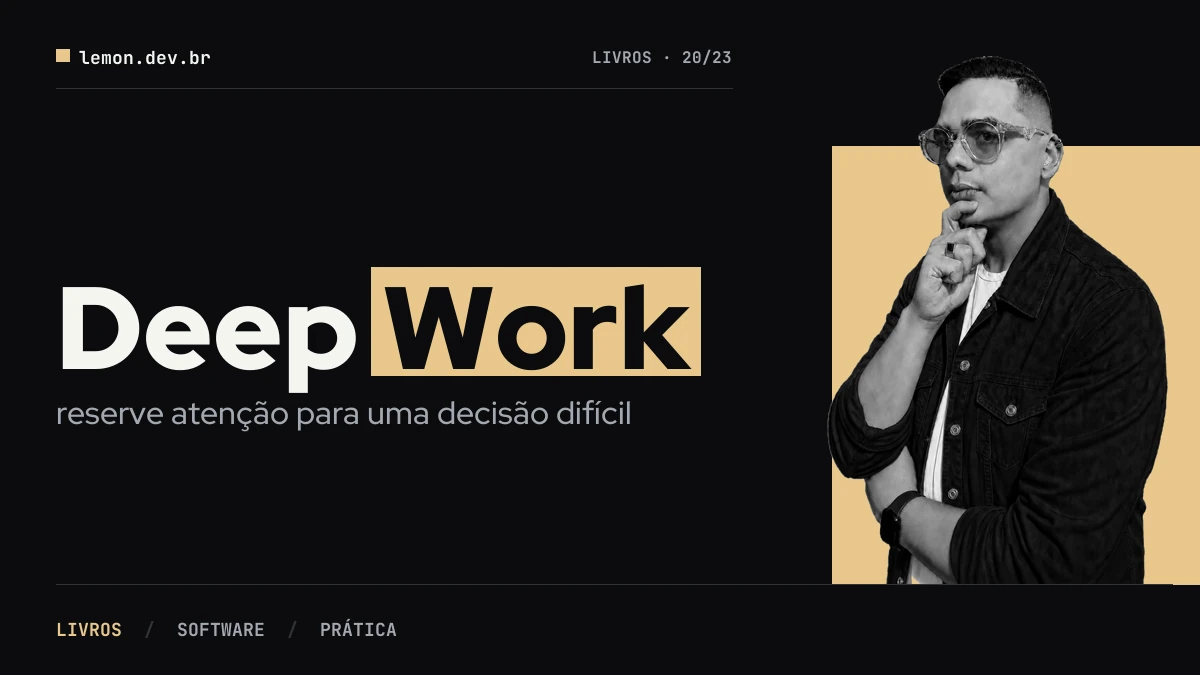
A production investigation rarely begins at the line where code fails. Someone has to recover context, understand dependencies, reconstruct a sequence and separate coincidence from cause. A message in the middle of that reasoning can cost more than the minutes spent answering it: the engineer must figure out where they were and rebuild part of the mental model. Cal Newport’s Deep Work examines this cost and suggests organizing work to create periods of concentration without turning focus into permanent isolation.
Newport defines deep work as professional activity performed with undistracted concentration on a cognitively demanding task. His argument is that this capacity enables people to learn complex material and produce valuable results, while always-on communication makes the capacity rarer. The publisher describes the book in two parts: an argument for the value of deep work, followed by four rules for bringing it into daily life (Hachette Book Group).
Those rules give the book its practical structure: work deeply, embrace boredom, quit social media and drain the shallows. The first calls for rituals and protected time; the second warns that constant switching trains us to seek quick stimulation; the third asks readers to evaluate tools by concrete benefits rather than any imaginable benefit; the fourth recommends making less room for low-value work. These are principles, not a universal sequence anyone can follow without negotiating their environment.
The book’s strongest move is replacing “How do I become more productive?” with operational questions: Which task requires continuous reasoning? What observable result should come out of it? Which interruptions are necessary? What low-value work could be reduced? For software engineers, these questions separate time spent busy from cognitive work. Reviewing a database migration, tracing a race condition and learning a new API may require sustained focus. Answering a domain question, triaging an incident and pairing also create value, though they are different kinds of work.
Programming means moving among code, system behavior, history, tests, data and hypotheses. Some of the work is writing; some is building a mental model that explains why a change is safe. This second part is often invisible on a task board. Someone can spend a morning in meetings and messages without getting a continuous opportunity to understand the riskiest defect.
The book helps make that work visible. “Investigate payment failure” is not a sufficiently defined goal for a focus block. A better outcome might be: reproduce the problem with a fixed set of events, locate the first divergence between expected and persisted state, and record a testable hypothesis. The result might be an explanation, a regression test or the discovery that necessary data is missing. The team can assess progress without confusing silent hours with delivery.
Newport also argues for choosing a focus mode that fits real life. Monastic work removes most obligations; bimodal work alternates long periods of isolation with collaboration; rhythmic work creates recurring blocks; journalistic work fits concentration into openings as they appear. For software teams, a rhythmic approach is often a reasonable starting point, but it still has to accommodate on-call duties, support, domain meetings, accessibility and external dependencies. The right strategy depends on the job’s actual contract, not a contest over who can protect the most hours.
Consider this hypothetical scenario: a team needs to migrate a service away from an old authentication library. Two behaviors are poorly documented, consumers run different versions, and a mistake could lock users out. The work will not fit in one block and should not happen in secret. Before the first session, the engineer agrees on a small objective with the team: identify which calls still depend on the old library and produce a test for one critical flow.
They reserve three 75-minute periods per week for two weeks. That adds up to 225 minutes, or 3 hours and 45 minutes each week. This arithmetic does not predict how many defects will be fixed; it only makes the commitment explicit so it can be compared with actual capacity. Between blocks, a teammate can review findings, provide logs or clarify a business rule. The engineer leaves a resume note on the ticket: current hypothesis, evidence found and next question.
Before starting, they arrange environment access and gather sample identifiers. During a block, interruptions go into three categories: genuine urgency, a dependency on someone else and an avoidable interruption. The record contains no names and is not used for individual performance evaluation. If a higher-priority incident appears, the agreement says to abandon the block and hand off context; service safety takes priority over a focus schedule.
After two weeks, the team compares what it learned, which dependencies remain open, whether the blocks were interrupted and how long it took to resume. Perhaps the sessions produced a useful test; perhaps they exposed an organizational dependency that requires another team. Both are informative outcomes. The experiment fails if “complete the block” becomes a goal by itself, detached from better decisions or migration quality.
Free and paid products to turn ideas into a foundation you can actually ship.
13 products available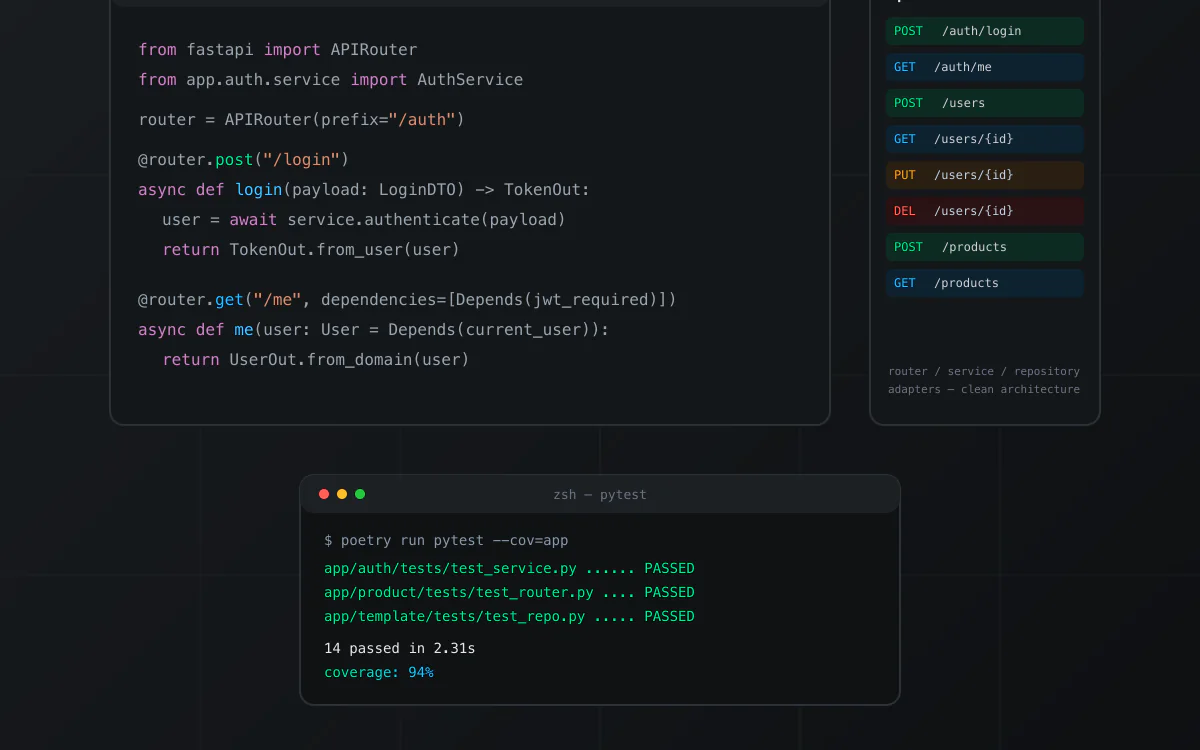
nextjs · boilerplate
Boilerplate de API em Python com FastAPI, organizado em Clean Architecture (router, service, repository e adapters por módulo). Inclui autenticação JWT com hashing bcrypt, MongoDB, testes com pytest e cobertura, Dockerfile e docker-compose para subir localmente, e documentação Swagger/OpenAPI automática. Repositório de origem privado; snapshot técnico verificado antes da publicação.
View product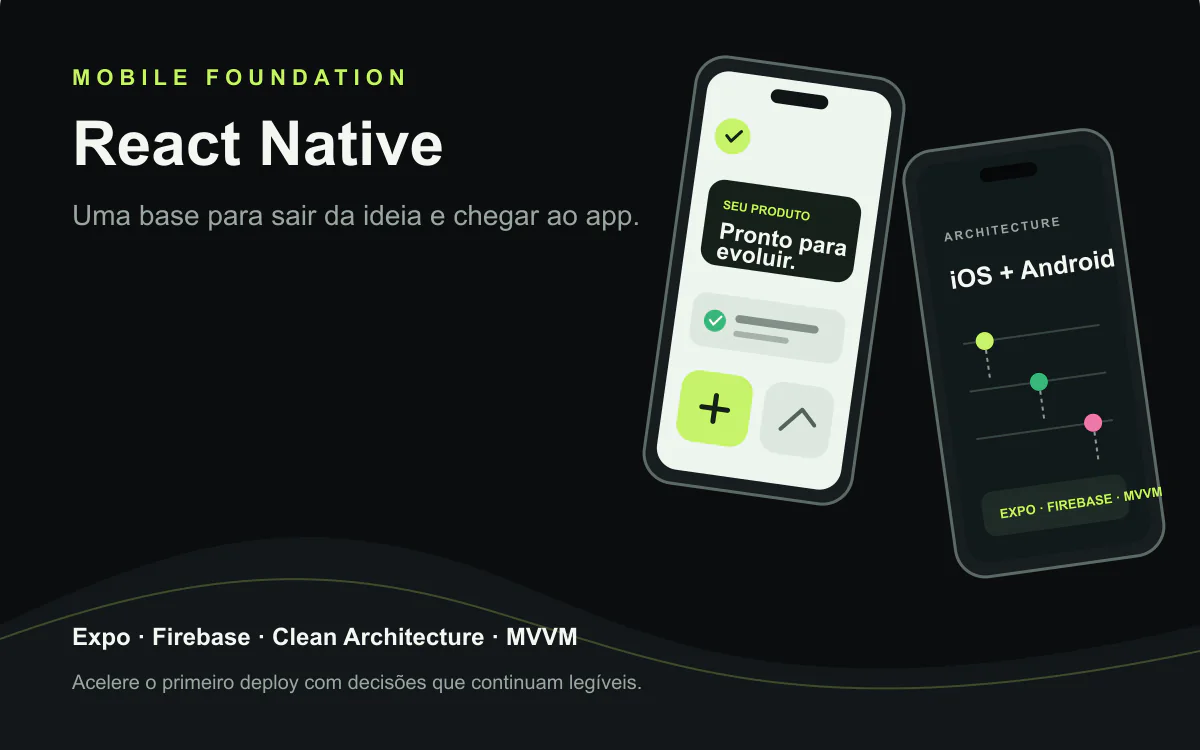
react · boilerplate
A React Native foundation for iOS and Android apps with Expo, Clean Architecture, MVVM, Firebase, and native modules. Technical reference from VaiDeFut, with public Google Play distribution and a documented iOS publishing flow.
View product
nextjs · boilerplate
A free open-source kit for getting started with coding agents across Claude Code, Codex, Gemini, Copilot, and OpenCode. The public repository confirms an MIT license.
View product
nextjs · boilerplate
A white-label AI-first foundation for shipping SaaS products with Next.js, chat, RAG, memory, tenants, and documentation. The verified snapshot documents Supabase rather than MongoDB; that limitation is explicit. MongoDB, Redis, and RabbitMQ require a compatible integration/configuration.
View product
nextjs · boilerplate
An advanced white-label, multi-tenant AI-first foundation for accelerating products with Next.js, chat, RAG, memory, and documentation. The verified snapshot does not prove a distinct Ultra layer; that limitation stays explicit while provider, cache, and queue swaps remain visible.
View product
nextjs · boilerplate
A white-label, multi-tenant foundation for turning an idea into an AI-first SaaS with Next.js, chat, RAG, memory, and documented security. The verified snapshot uses Supabase; the name identifies the source repository. Provider, cache, and queue boundaries stay explicit; Redis and RabbitMQ are configurable integrations.
View product
react · portfolio
A one-time contribution that supports free technical content, research, and the continuity of relevant projects published by Anderson Lima. You choose the amount; there is no subscription.
View product
react · boilerplate
A free React starter for building a reliable test suite from the first commit, combining Vitest, Testing Library, Playwright, Vite, TypeScript, Zustand, React Query, MirageJS, and PWA. The repository does not declare an SPDX license; review its terms before commercial use.
View product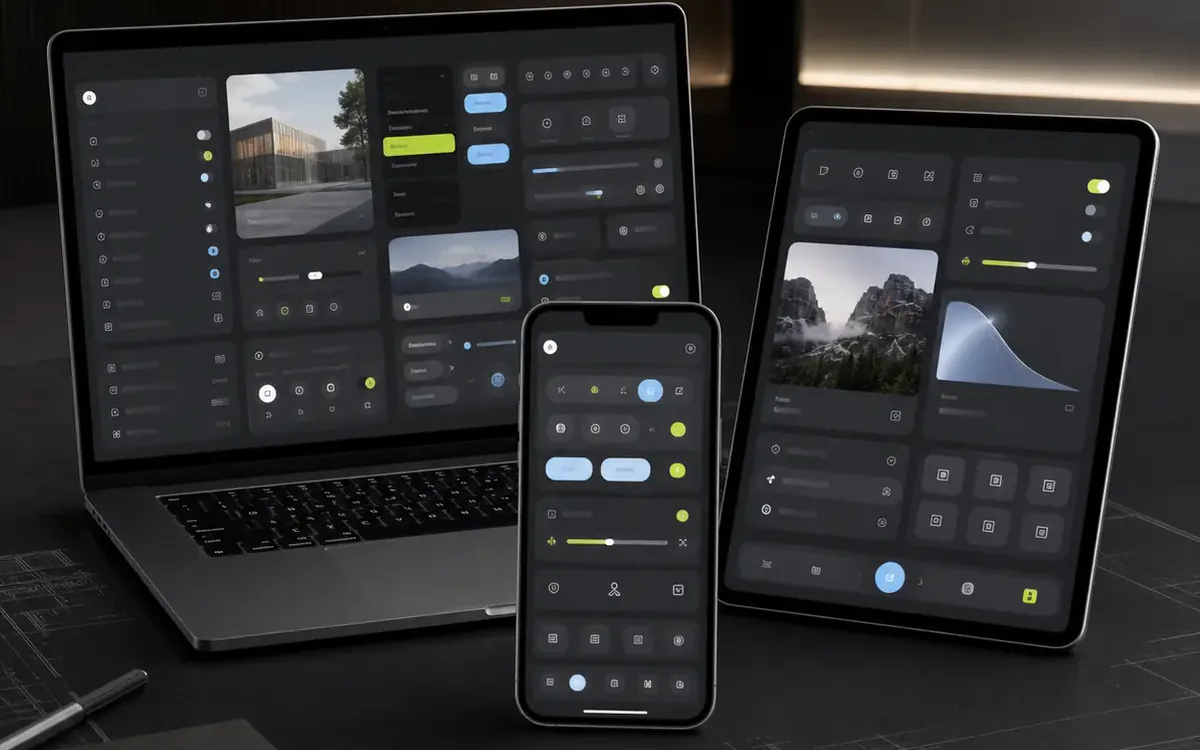
react · portfolio
A public React, TypeScript, and Vite monorepo for exploring a component library with a native-inspired visual language. The current README is minimal and does not declare an SPDX license; treat it as a free preview.
View product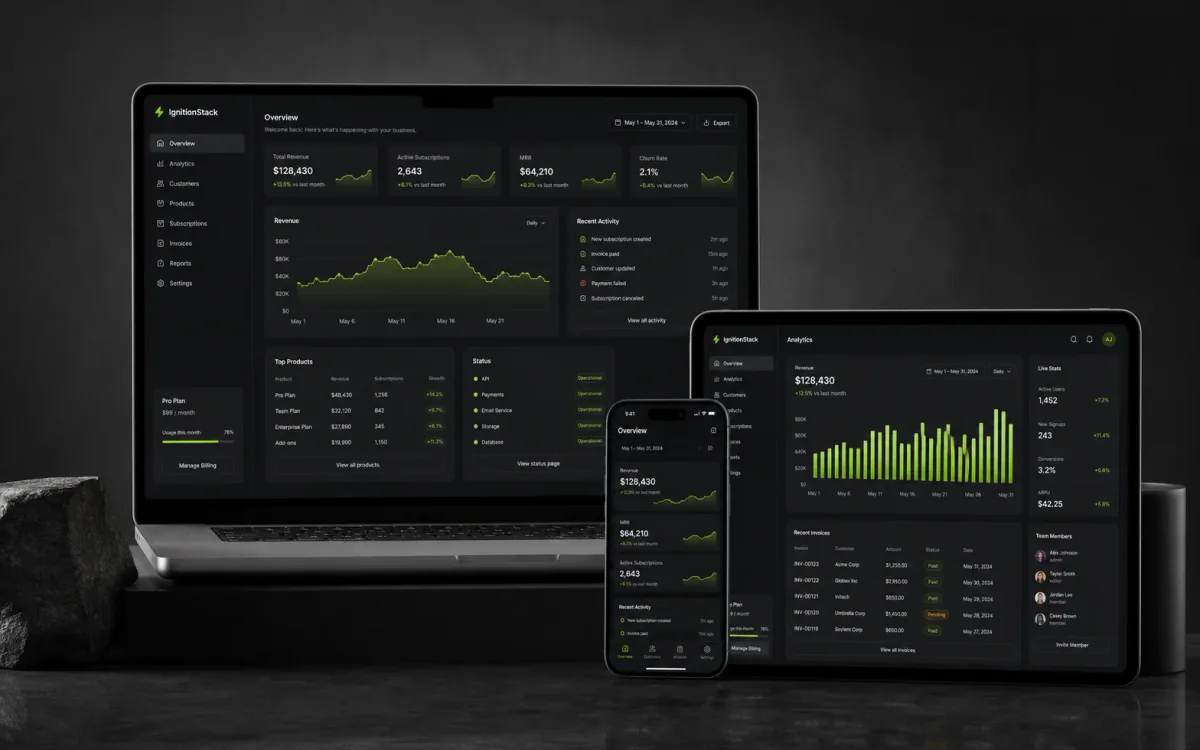
nextjs · saas
An AI-first SaaS boilerplate with Next.js, Supabase, Stripe, and provider routing to move from the first prompt toward a real deployment faster. AI, data, email, cache, and queue adaptations stay explicit; Redis and RabbitMQ are configurable integrations.
View product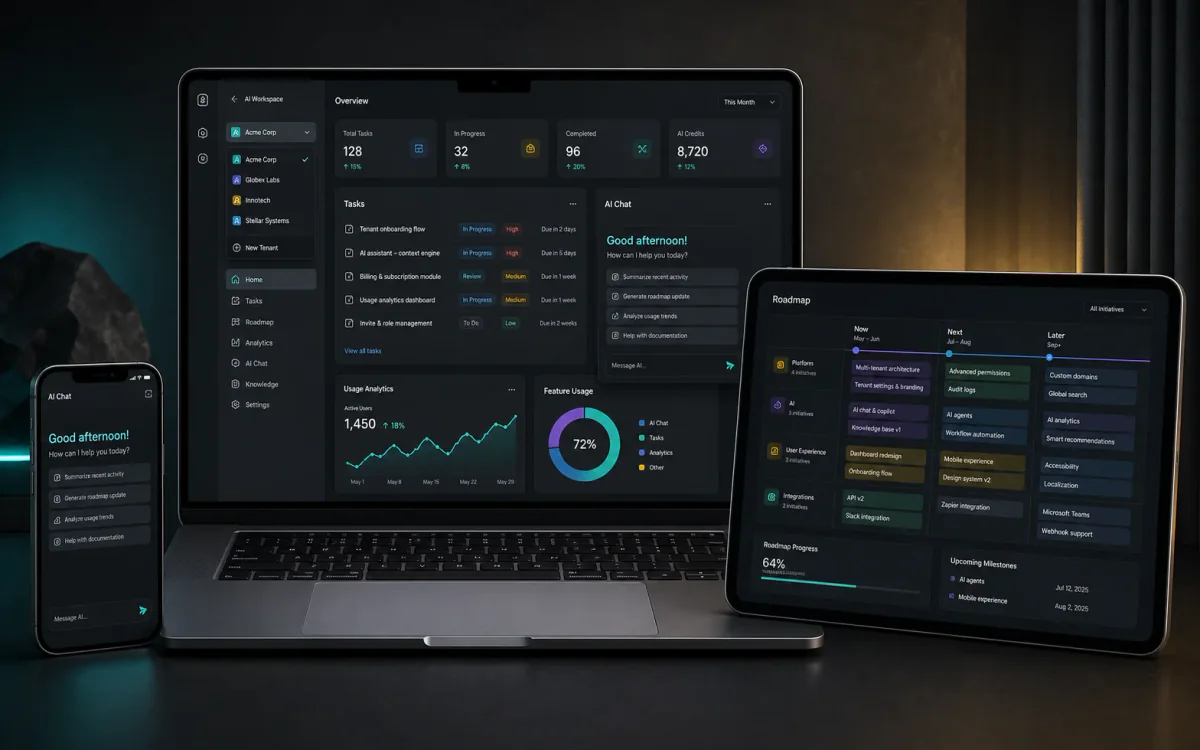
react · saas
A React + TypeScript starter for multi-tenant SaaS with Firebase, Atomic Design, themes, PWA, product screens, MirageJS, and Gemini chat extensible to other providers. Validate production requirements, costs, and integrations before publishing.
View product
react · boilerplate
A public React starter with TypeScript, Zustand, React Query, Tailwind CSS, PWA, and documented AI integrations. The repository does not declare an SPDX license; review its terms before commercial use.
View product
nextjs · saas
A Next.js, TypeScript, and Tailwind CSS SaaS landing page with SEO, themes, i18n, PWA, and integration points for auth, Stripe, and AI. A clear foundation for leaving the blank screen behind and shaping your positioning.
View productContinue exploring similar topics
A review of The Pragmatic Programmer's anniversary edition: DRY, reversibility, prototypes and feedback examined through an inventory-import scenario.

Apply Michael Nygard's approach to timeouts, isolation and recovery through a controlled failure exercise.

Turn passive study into a learning project with direct practice, feedback and spaced retrieval.
A 47-point checklist to find bugs, security risks, and performance issues before launch.
Production-tested templates trusted by developers. Save weeks of setup on your next project.
The book is right to treat attention as limited and to recommend changes to the work system, not only willpower tricks. Starting rituals, a clear definition of the intended output, batching shallow tasks and a shutdown note can reduce friction. Its point that difficult learning requires practice without constant switching also connects with Ultralearning, although the books answer different questions: Newport discusses conditions for concentration; Scott Young organizes direct-learning projects.
Another strength is acknowledging that no single rhythm fits every person. Still, the text is more persuasive as an essay and collection of heuristics than as proof that reserving long periods causes better outcomes in every profession. Newport draws on research, examples and personal stories, but those examples are not controlled trials of every rule. Readers should treat quantitative recommendations and success stories as hypotheses to test in their own context, not universal targets.
The distinction between deep and shallow work can also oversimplify hybrid activities. A code review may look routine but surface an architectural decision; a meeting may be shallow, or it may be the only way to resolve business ambiguity. The label should not replace analysis of value, risk and dependencies. If an organization rewards immediate replies but changes no expectations, asking individuals to focus merely shifts pressure to coworkers and customers.
This limit is especially clear for on-call engineers, support staff, team leads, caregivers and people with little control over their calendars. A notification-free window may be impossible, and that does not prove a lack of discipline. Newport discusses different routines and the need to negotiate commitments, but readers must adapt the method to constraints of power, health and accessibility. Predictable availability and agreed coverage matter more than silence imposed unilaterally.
“Quit social media” is the rule most easily applied dogmatically. The useful argument is to evaluate a tool against a goal and observe its attention cost. The answer need not be deleting every account: it might mean removing notifications, limiting checks to certain times, keeping a work channel that is necessary or deciding that a tool provides enough value. Indistractable, by Nir Eyal, complements the subject from another angle: it examines triggers and the difference between a chosen interruption and a distraction that pulls someone away from an intended activity.
Start with a task that actually requires sustained reasoning, not an abstract goal to “focus more.” Write down a question, an artifact that could answer it and a condition for stopping or asking for help. Choose a duration that fits the task; 40 minutes of analysis may be more realistic than a whole morning. If an investigation needs continuity over several days, a resume note may be more valuable than trying to maintain peak attention for hours.
Next, agree on the window with people who depend on you. Define the emergency channel, coverage for the period, a time for ordinary requests and the rule for interrupting the block. Availability no longer means either “I answer everything immediately” or “do not interrupt me”; it becomes an agreement the team can check. If the team cannot guarantee coverage, shorten the period or choose a different task.
For a short trial, record outcomes and coordination costs: whether the hypothesis was confirmed or rejected, a test created, a decision made, external blockers, necessary interruptions and lost resume time. Compare similar tasks without turning focused minutes into an individual scoreboard. If you did not finish, ask whether the scope was too large, context was missing or the work mode was wrong. The right next move might be pairing, interviewing a domain expert or requesting a decision—not booking another block.
At the end of each session, leave three lines: what is established, what remains uncertain and which next step depends on whom. That output makes review and collaboration easier. The goal is not to protect focus at any cost; it is to spend attention on problems that deserve reasoning while keeping visible the work that lets the rest of the team move forward.
Deep Work is useful for people who see important tasks repeatedly displaced by quick-response work and have some room to negotiate their routines. Developers investigating complex failures, learning new technologies or preparing high-risk changes will find useful questions for designing work blocks and evaluating results. Leads can use it to review availability expectations and reduce needless interruptions, provided they also take responsibility for coverage and priorities.
It is less suitable as an individual prescription for people who do not control their calendars, depend on continuous service or face problems requiring immediate collaboration. In those situations, the book can help name the cost of fragmentation, but it cannot remove the causes on its own. Read it as an invitation to experiment with better working conditions, not as a judgment of who can or cannot go uninterrupted.
Verdict: a practical, challenging book about a valuable skill in software, with useful advice for shaping routines and a thesis worth testing rather than following literally. Its best contribution is asking for an explicit choice: Which outcome needs continuous attention? What availability must the team preserve? What evidence would show that the arrangement helped? If those questions produce a small, reviewable experiment, the reading has paid off.