How the Heroku-born manifesto became the foundation of scalable, secure, and AI-ready software in the modern cloud.
In 2011, engineers at Heroku introduced the Twelve-Factor App methodology — a set of principles to guide the development of scalable, maintainable, deployable cloud applications. oai_citation:0‡Twelve-Factor App Over a decade later, while the infrastructure landscape has shifted dramatically with containers, service meshes, serverless, and GitOps, many of the original principles remain deeply relevant — albeit with caveats and necessary evolution.
This post revisits all 12 factors (based on the original and Portuguese version at 12factor.net/pt_br) and explores their significance in 2025. I’ll also reference the version from Alura’s explanations and modern adaptations. See: Alura — The Twelve Factor App oai_citation:1‡GitHub
Finally, I propose extensions and adaptations for modern architectures, and tips to apply or refactor toward these principles today.
Before diving into each factor, it's worth asking: does 12-Factor still matter?
Thus, 12-Factor remains a valuable lens — but one should interpret and adapt, not rigidly follow.
Let’s revisit each factor, with commentary on modern relevance, trade-offs, and evolution.
Below is a factor-by-factor analysis: what it originally meant, its enduring relevance (or limitations), and how to adapt it in today’s world.
Original intent:
One application should have exactly one codebase in version control, with potentially multiple deploys (dev, staging, prod). oai_citation:5‡Twelve-Factor App
Modern relevance / challenges:
Adaptation tips:
Original intent:
No implicit reliance on global system packages; all dependencies must be declared (e.g. package.json, Gemfile, etc.). oai_citation:6‡Twelve-Factor App
Modern relevance / challenges:
Adaptation tips:
package-lock.json, Pipfile.lock) to freeze versions.Original intent:
Keep configuration (that differs per environment) out of the code; use environment variables (or similar) for settings like credentials, URLs, toggles. oai_citation:7‡Twelve-Factor App
Modern relevance / challenges:
Adaptation tips:
Original intent:
Databases, caches, message brokers, external services should be treated as “attached” via a URL or resource locator, and replaceable without code changes. oai_citation:9‡Twelve-Factor App
Modern relevance / challenges:
Adaptation tips:
Original intent:
A clean pipeline with three stages:
Modern relevance / challenges:
Adaptation tips:
Original intent:
Processes should be stateless; any persistent state should be offloaded to backing services. oai_citation:11‡Twelve-Factor App
Modern relevance / challenges:
Adaptation tips:
Original intent:
Your application is self-contained and listens on a port; you don’t implicitly rely on a web server container (like Apache) in front. oai_citation:12‡Twelve-Factor App
Modern relevance / challenges:
PORT).Adaptation tips:
PORT), not hardcoded.Original intent:
Scale by running multiple processes of specific types (e.g. web, worker) rather than threads or monolithic scaling. oai_citation:13‡Twelve-Factor App
Modern relevance / challenges:
Adaptation tips:
Original intent:
Applications should start quickly and shutdown gracefully (e.g. respond to SIGTERM, drain connections). oai_citation:14‡Twelve-Factor App
Modern relevance / challenges:
Adaptation tips:
Original intent:
Minimize the gap between development and production: time, personnel, tools, and dependencies. oai_citation:15‡Twelve-Factor App
Modern relevance / challenges:
Adaptation tips:
Original intent:
Don’t manage log files; instead, stream logs to stdout/stderr and let the execution environment aggregate or route them. oai_citation:16‡Twelve-Factor App
Modern relevance / challenges:
Adaptation tips:
Original intent:
Any administrative or management tasks (migrations, consoles, scripts) should be run as one-off processes in the same environment as the app. oai_citation:17‡Twelve-Factor App
Modern relevance / challenges:
docker run … manage.py migrate, or kubectl exec to run tasks).Adaptation tips:
The original 12 factors were powerful, but new architectural trends suggest additional considerations that weren’t explicit in 2011. Here are some extensions or newer viewpoints to incorporate:
While logging is included, the original manifesto didn’t emphasize metrics, tracing, or application-level observability. In 2025, distributed tracing and rich telemetry are essential for diagnosing complex systems.
The original config factor handles secrets implicitly via environment, but modern systems require secret rotation, encryption at rest, audit logs, and dynamic injection (Vault, KMS).
For SaaS platforms, multi-tenancy and tenant isolation (data, compute) are core concerns. The original manifesto didn’t address multitenancy directly.
In some architectures, parts of the app may run on edge (CDN functions), others in the cloud. Coordinating consistency, state, and distribution across those is beyond original scope.
With increasing emphasis on PaaS, developer platforms, internal platforms, the boundary between “app code” and “platform code” requires clean contracts — analogous to the “narrow-waist” / “narrow conduit” concept in modern manifesto updates. oai_citation:18‡Twelve-Factor App
Applications with AI/ML pipelines often involve heavy state, model artifacts, cache, data stores — frameworks like “12-Factor Agents” have been proposed to adapt the methodology to such use cases. oai_citation:19‡IKANGAI
Here’s a suggested roadmap (for new or existing projects) to adopt or improve adherence to the 12-factor style in 2025:
| Phase | Focus | Example Tasks |
|---|---|---|
| Assessment | Evaluate violations and risk areas | Audit config practices, stateful dependencies, logging, scaling bottlenecks |
| Modularization | Break monoliths or shared modules into services | Introduce interfaces, adapters, versioned modules |
| Pipeline modernization | Introduce build-release-run separation | Use CI/CD to build versioned artifacts, deploy reproducibly |
| State externalization | Move sessions, caches, local state to backing services | Use Redis, DB, or managed state stores |
| Config & secret overhaul | Migrate config into typed environment loading or secret stores | Introduce config libraries, secret management |
| Observability & telemetry | Add metrics, tracing, dashboards | Integrate OpenTelemetry, correlation ID propagation |
| Graceful lifecycle | Add signal handling, probes, shutdown logic | Kubernetes readiness/liveness, SIGTERM handlers |
| Scaling strategy | Define process types, autoscaling rules | Distinct web, background, cron processes |
| Admin tooling | Version admin scripts, run them in the same environment | Use one-off task patterns |
| Tests & staging alignment | Ensure staging mirrors production | Use same stacks, data subsets, performance testing |
Over time, aim to incrementally evolve toward stronger adherence — avoiding a “big bang rewrite” unless critically necessary.
The Twelve-Factor methodology remains one of the most enduring frameworks for designing cloud-native applications. In 2025, its principles still offer a solid foundation — but with appropriate adaptation to modern paradigms like containers, observability, secrets management, multi-tenancy, and hybrid architectures.
The key takeaway: use 12-Factor as a guiding philosophy, not a rigid rulebook. Analyze which factors make the most impact in your context, incrementally adopt improvements, and extend them where your use cases demand it.
Software Engineer
I'm a software engineer with over 10 years building B2B and B2C platforms for fintech, healthcare, and education companies. Postgraduate in software architecture and solutions, I connect technical vision with business results to deliver experiences that make sense to people. I also mentor devs and creators in live classes, podcasts, and community initiatives focused on inclusive technology.
Free and paid products to turn ideas into a foundation you can actually ship.
13 products available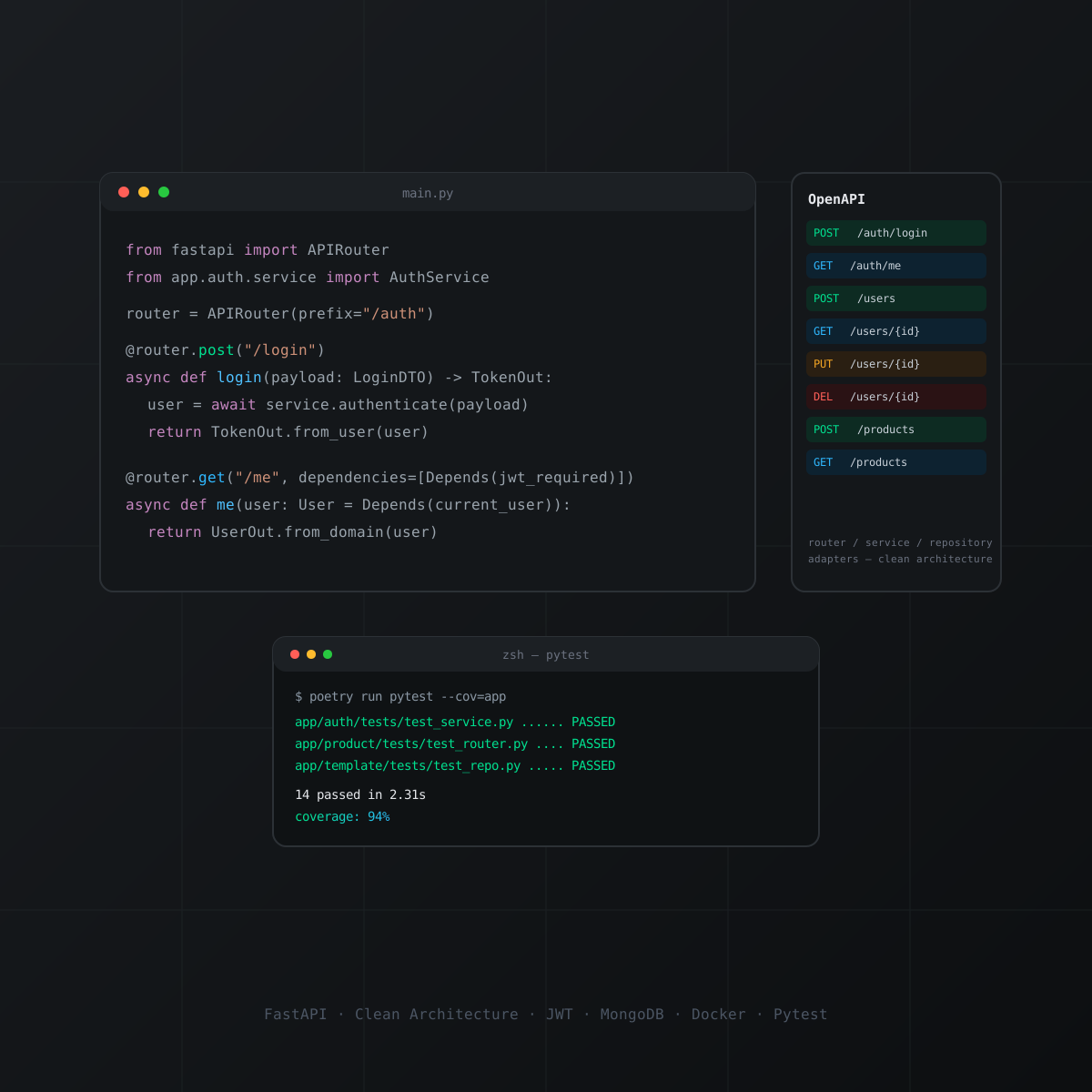
nextjs · boilerplate
Boilerplate de API em Python com FastAPI, organizado em Clean Architecture (router, service, repository e adapters por módulo). Inclui autenticação JWT com hashing bcrypt, MongoDB, testes com pytest e cobertura, Dockerfile e docker-compose para subir localmente, e documentação Swagger/OpenAPI automática. Repositório de origem privado; snapshot técnico verificado antes da publicação.
View product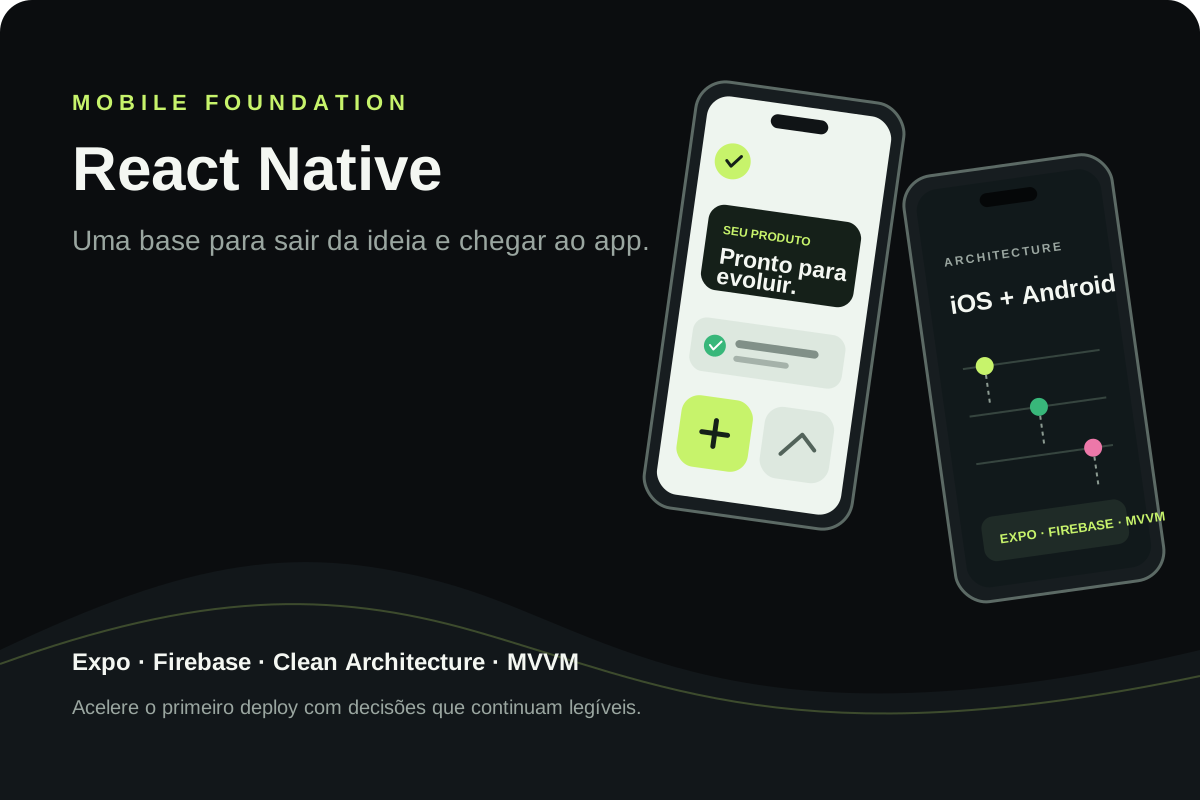
react · boilerplate
A React Native foundation for iOS and Android apps with Expo, Clean Architecture, MVVM, Firebase, and native modules. Technical reference from VaiDeFut, with public Google Play distribution and a documented iOS publishing flow.
View product
nextjs · boilerplate
A free open-source kit for getting started with coding agents across Claude Code, Codex, Gemini, Copilot, and OpenCode. The public repository confirms an MIT license.
View product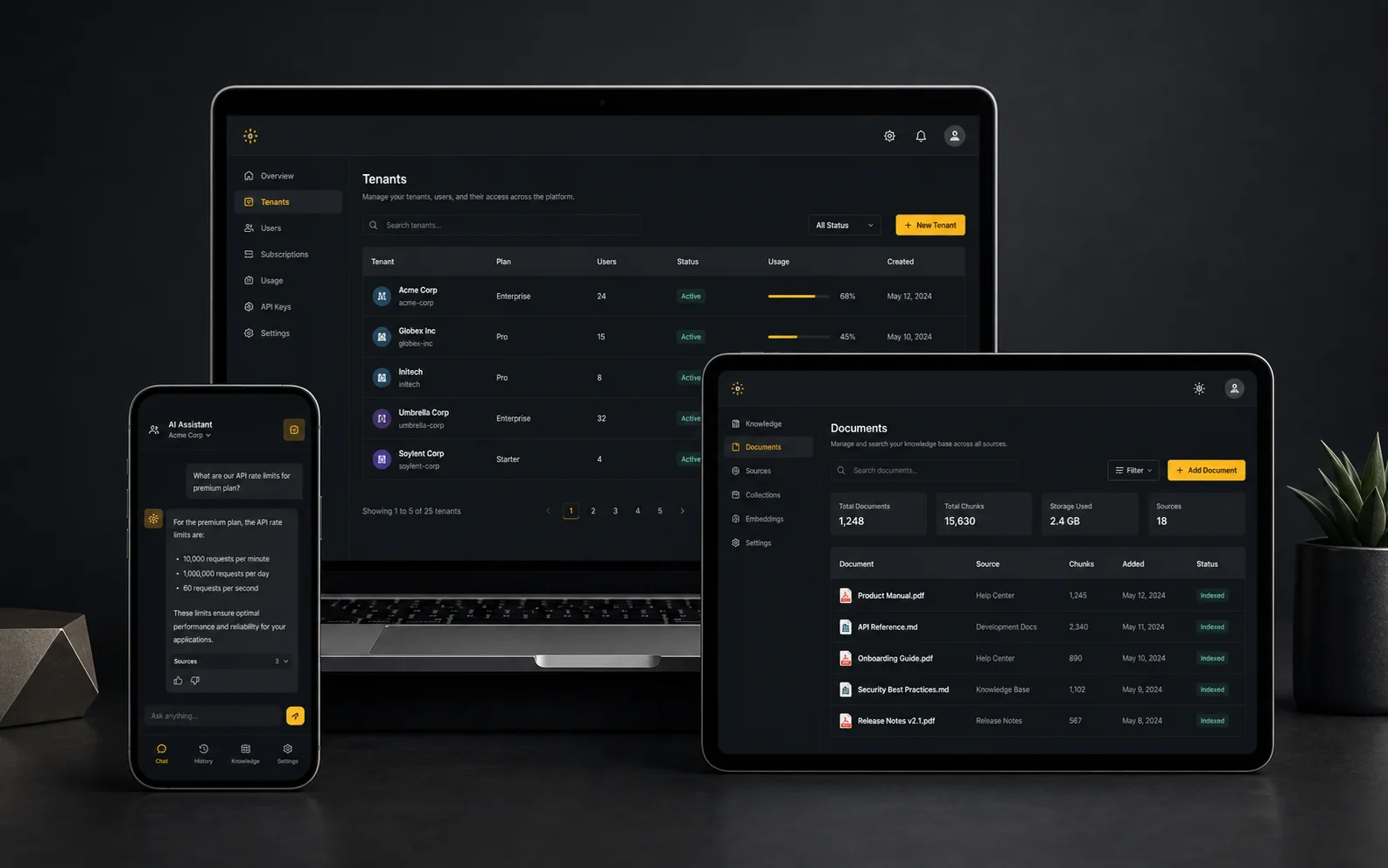
nextjs · boilerplate
A white-label AI-first foundation for shipping SaaS products with Next.js, chat, RAG, memory, tenants, and documentation. The verified snapshot documents Supabase rather than MongoDB; that limitation is explicit. MongoDB, Redis, and RabbitMQ require a compatible integration/configuration.
View productnextjs · boilerplate
An advanced white-label, multi-tenant AI-first foundation for accelerating products with Next.js, chat, RAG, memory, and documentation. The verified snapshot does not prove a distinct Ultra layer; that limitation stays explicit while provider, cache, and queue swaps remain visible.
View productnextjs · boilerplate
A white-label, multi-tenant foundation for turning an idea into an AI-first SaaS with Next.js, chat, RAG, memory, and documented security. The verified snapshot uses Supabase; the name identifies the source repository. Provider, cache, and queue boundaries stay explicit; Redis and RabbitMQ are configurable integrations.
View product
react · portfolio
A one-time contribution that supports free technical content, research, and the continuity of relevant projects published by Anderson Lima. You choose the amount; there is no subscription.
View product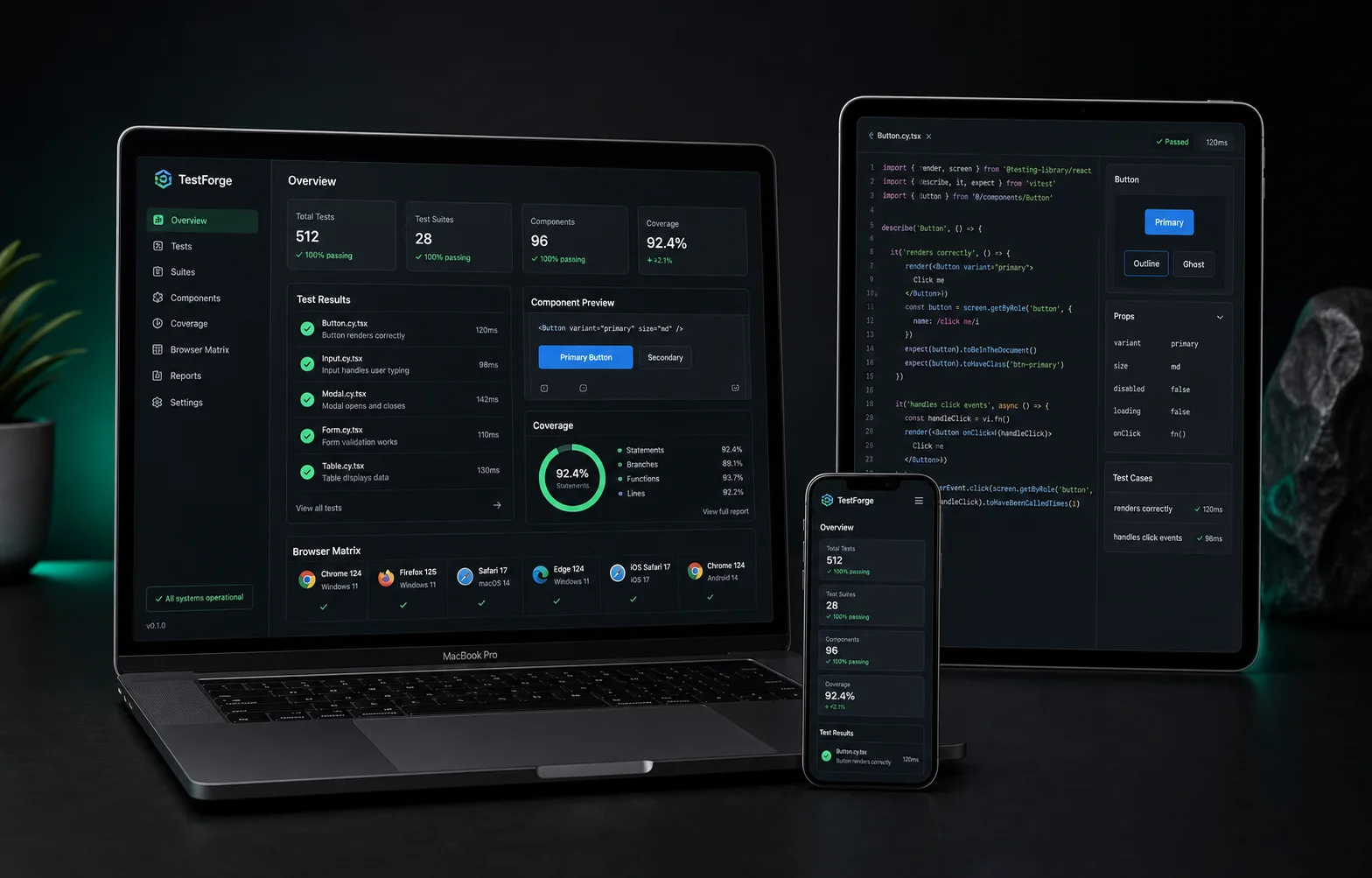
react · boilerplate
A free React starter for building a reliable test suite from the first commit, combining Vitest, Testing Library, Playwright, Vite, TypeScript, Zustand, React Query, MirageJS, and PWA. The repository does not declare an SPDX license; review its terms before commercial use.
View product
react · portfolio
A public React, TypeScript, and Vite monorepo for exploring a component library with a native-inspired visual language. The current README is minimal and does not declare an SPDX license; treat it as a free preview.
View product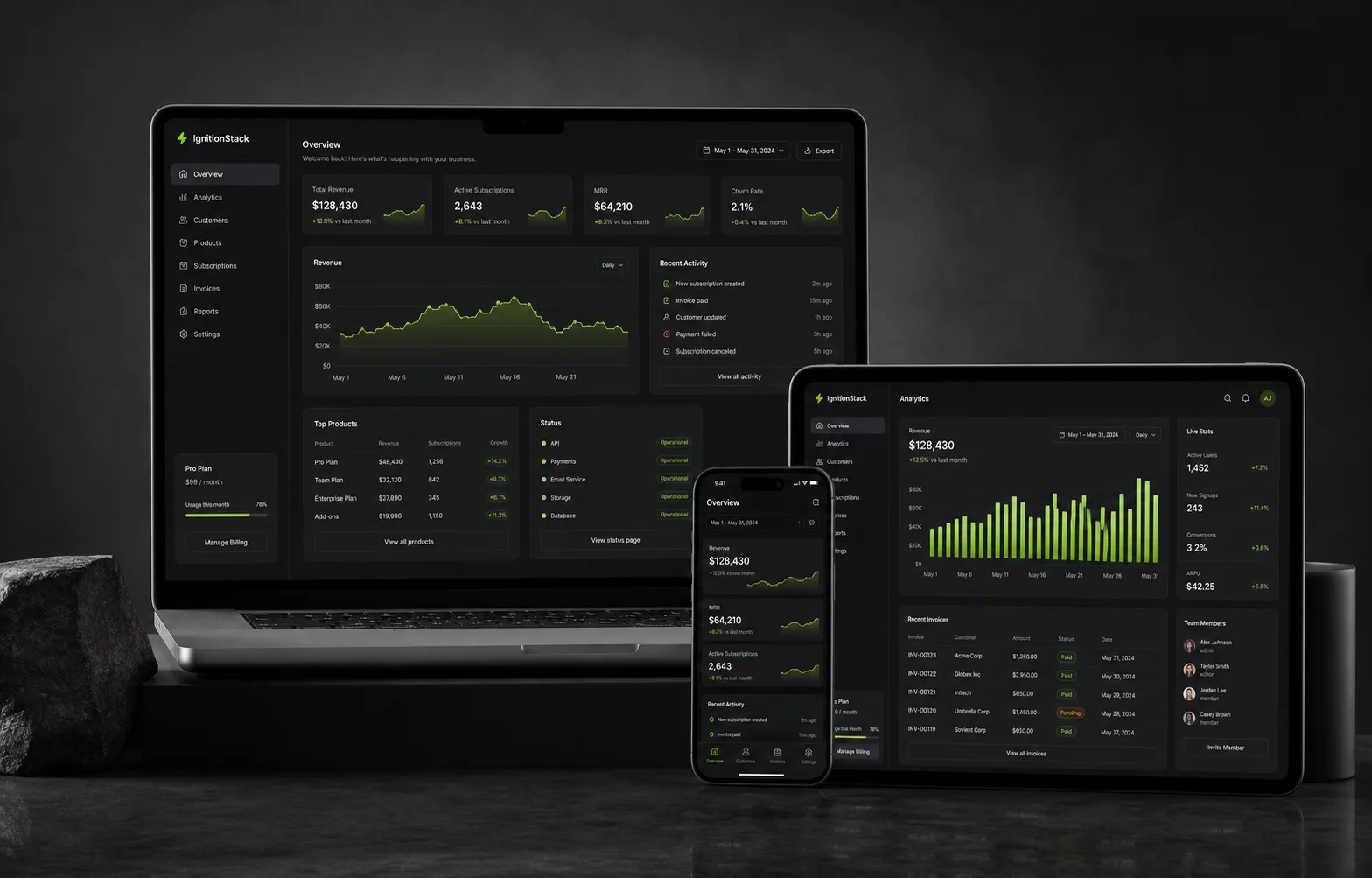
nextjs · saas
An AI-first SaaS boilerplate with Next.js, Supabase, Stripe, and provider routing to move from the first prompt toward a real deployment faster. AI, data, email, cache, and queue adaptations stay explicit; Redis and RabbitMQ are configurable integrations.
View product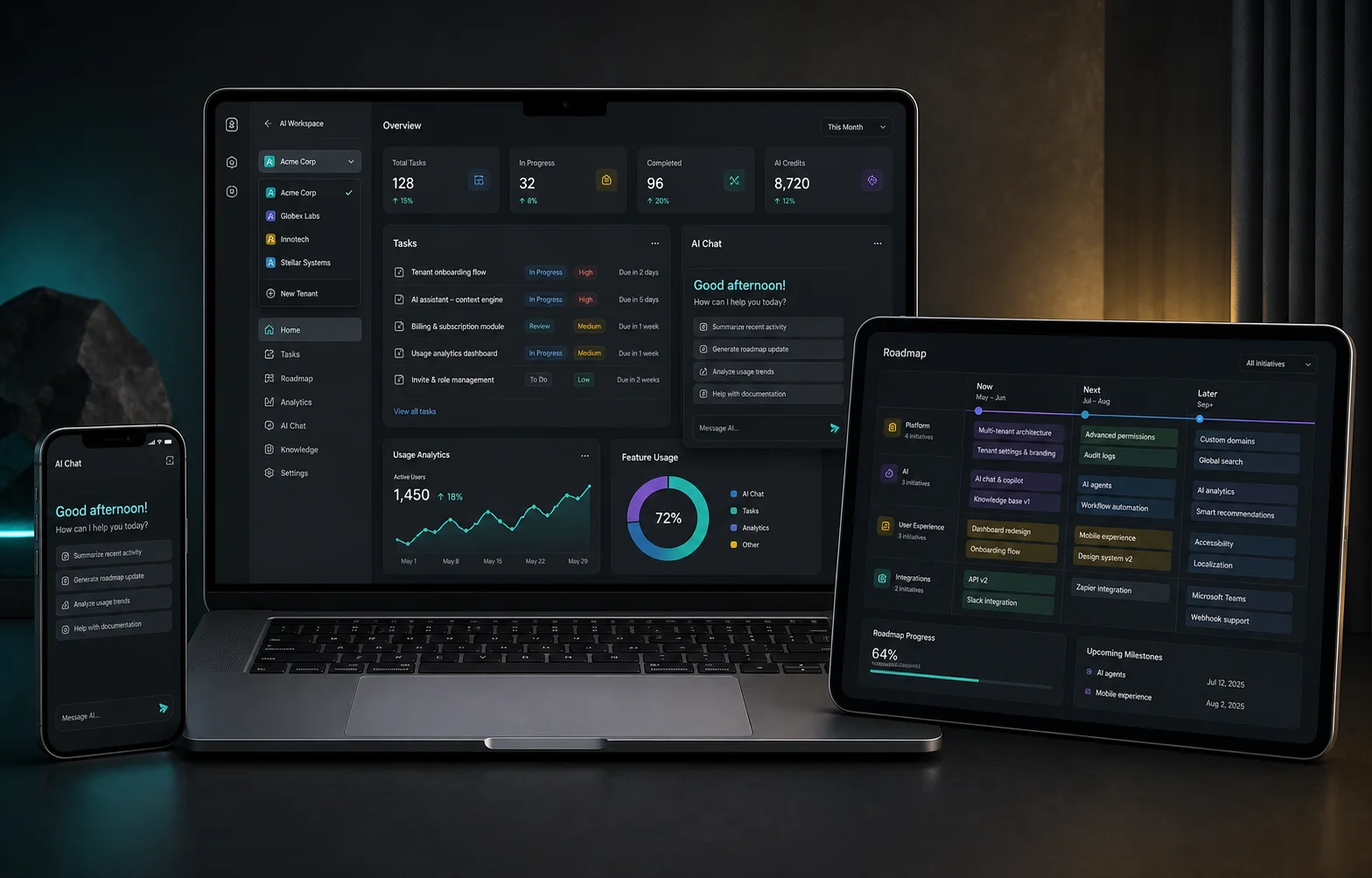
react · saas
A React + TypeScript starter for multi-tenant SaaS with Firebase, Atomic Design, themes, PWA, product screens, MirageJS, and Gemini chat extensible to other providers. Validate production requirements, costs, and integrations before publishing.
View product
react · boilerplate
A public React starter with TypeScript, Zustand, React Query, Tailwind CSS, PWA, and documented AI integrations. The repository does not declare an SPDX license; review its terms before commercial use.
View product
nextjs · saas
A Next.js, TypeScript, and Tailwind CSS SaaS landing page with SEO, themes, i18n, PWA, and integration points for auth, Stripe, and AI. A clear foundation for leaving the blank screen behind and shaping your positioning.
View productContinue exploring similar topics

Uma visão clara e prática sobre os pilares que sustentam aplicações web e mobile modernas: Clean Architecture, modularidade distribuída, performance extrema e segurança avançada. Um guia essencial para quem quer construir sistemas escaláveis e preparados para o futuro.

As primeiras semanas de 2026 já revelam mudanças profundas no setor de tecnologia. Neste artigo, exploramos como a inteligência artificial se tornou um imperativo estratégico, quais novas funções estão surgindo no mercado, as principais tendências em desenvolvimento de software, DevOps e linguagens de programação, além dos anúncios mais relevantes da CES 2026 e avanços em hardware, robótica e computação quântica. Um guia essencial para desenvolvedores, líderes técnicos e profissionais que querem se manter relevantes no futuro da tecnologia.
Como desenhar o sistema completo de um banco digital de ponta a ponta — do ledger de partidas dobradas e idempotência financeira até event sourcing, sagas, antifraude e os trade-offs de consistência do Teorema CAP. Guia hiperdetalhado, com diagramas e TypeScript real.
A 47-point checklist to find bugs, security risks, and performance issues before launch.
Production-tested templates trusted by developers. Save weeks of setup on your next project.